Identify the product when each of the following reactions is performed on the triglyceride of linoleic acid (linoleate). (a) H2 , Pd
Verified step by step guidance
1
Step 1: Analyze the structure of linoleate triglyceride. It consists of a glycerol backbone esterified with three fatty acid chains, each containing two double bonds in the cis configuration.
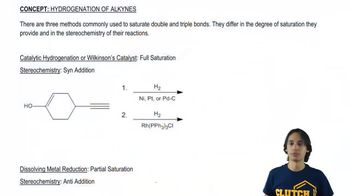
Step 2: Understand the reaction conditions. The presence of H₂ and Pd indicates a catalytic hydrogenation reaction, which typically reduces double bonds in unsaturated compounds to single bonds.
Step 3: Predict the effect of hydrogenation on the fatty acid chains. The double bonds in the linoleate triglyceride will be converted to single bonds, resulting in saturated fatty acid chains.
Step 4: Note that the glycerol backbone and ester linkages remain unaffected during hydrogenation, as the reaction specifically targets the double bonds in the fatty acid chains.
Step 5: The final product will be a triglyceride with fully saturated fatty acid chains, as all double bonds are reduced to single bonds under these conditions.
Verified video answer for a similar problem:
This video solution was recommended by our tutors as helpful for the problem above
Play a video:
Was this helpful?
Key Concepts
Here are the essential concepts you must grasp in order to answer the question correctly.
Triglycerides
Triglycerides are esters formed from glycerol and three fatty acids. They are the main constituents of body fat in humans and animals, as well as vegetable fat. In the case of linoleic acid, which is a polyunsaturated fatty acid, the triglyceride will contain multiple double bonds, influencing its reactivity and the products formed during chemical reactions.
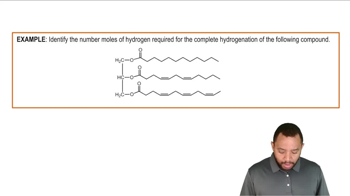
Triacylglycerol Reactions: Hydrogenation Example 1
Hydrogenation
Hydrogenation is a chemical reaction that involves the addition of hydrogen (H₂) to unsaturated bonds, typically double bonds in alkenes or alkynes. In the presence of a catalyst like palladium (Pd), hydrogenation converts unsaturated fatty acids into saturated ones, which can alter the physical properties of the triglyceride, such as melting point and stability.
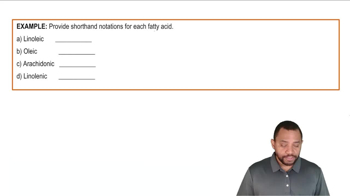
Linoleic acid is an essential polyunsaturated fatty acid with two double bonds, classified as an omega-6 fatty acid. It plays a crucial role in human health and is a key component of cell membranes. Understanding its structure and reactivity is vital for predicting the outcome of reactions, such as hydrogenation, which can lead to the formation of different fatty acid derivatives.