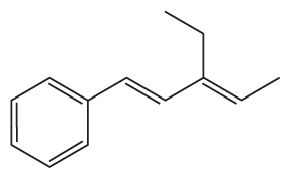
What vinylic halide couples with styrene (C6H5-CH=CH2) in order to synthesize each of the following compounds using a Heck reaction? c.
Verified step by step guidance
1
Step 1: Recognize that the Heck reaction involves coupling a vinylic halide with an alkene, facilitated by a palladium catalyst (L2Pd) and a base such as triethylamine ((CH3CH2)3N). The product is formed by the substitution of the halide with the alkene, creating a new C-C bond.
Step 2: Analyze the target product structure. The product contains a styrene moiety (C6H5-CH=CH2) coupled to a vinylcyclopentane group. This indicates that the vinylic halide must contain the cyclopentane ring and the vinyl group.
Step 3: Identify the vinylic halide structure required. The halide must be attached to the vinyl group and the cyclopentane ring. This structure corresponds to vinylcyclopentane with a halogen atom (e.g., bromine or iodine) attached to the vinyl group.
Step 4: Write the chemical structure of the vinylic halide. The halide should be CH2=CH-X, where X is the halogen (e.g., Br or I), and it is bonded to the cyclopentane ring. This ensures compatibility with the Heck reaction mechanism.
Step 5: Confirm the reaction conditions. The palladium catalyst (L2Pd) and triethylamine base facilitate the coupling reaction, ensuring the formation of the desired product by replacing the halogen with the styrene moiety.
Verified video answer for a similar problem:
This video solution was recommended by our tutors as helpful for the problem above
Video duration:
3m
Play a video:
Was this helpful?
Key Concepts
Here are the essential concepts you must grasp in order to answer the question correctly.
Heck Reaction
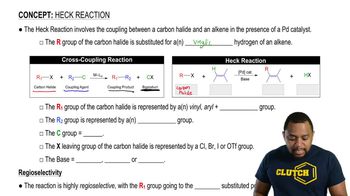
The Heck reaction is a palladium-catalyzed coupling reaction between an aryl or vinyl halide and an alkene, resulting in the formation of substituted alkenes. This reaction is significant in organic synthesis for constructing complex molecules and is widely used in the pharmaceutical and materials industries. The reaction typically requires a base and a palladium catalyst to facilitate the coupling process.
Vinylic halides are organic compounds where a halogen atom is bonded to a carbon atom that is part of a double bond (alkene). They are important intermediates in organic synthesis, particularly in reactions like the Heck reaction, where they can couple with alkenes to form more complex structures. Understanding the reactivity and properties of vinylic halides is crucial for predicting the outcomes of coupling reactions.
Alkenes are hydrocarbons that contain at least one carbon-carbon double bond, making them more reactive than alkanes. Their reactivity is influenced by factors such as sterics and electronics, which affect how they participate in reactions like the Heck reaction. In this context, the ability of an alkene to undergo coupling with a vinylic halide is essential for synthesizing desired products, as seen in the provided reaction scheme.