For those compounds that can be prepared by a Heck reaction, what starting materials are required?
Verified step by step guidance
1
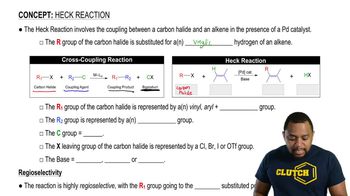
Step 1: Understand the Heck reaction. The Heck reaction is a palladium-catalyzed coupling reaction between an aryl or vinyl halide and an alkene, forming a substituted alkene. It requires a palladium catalyst, a base, and typically proceeds via a syn addition mechanism.
Step 2: Analyze the target compound provided in the image. The compound consists of a biphenyl structure where one phenyl ring is directly attached to a cyclohexene ring. This suggests that the Heck reaction could be used to form the bond between the phenyl group and the cyclohexene ring.
Step 3: Identify the starting materials. For the Heck reaction, you need an aryl halide (such as bromobenzene or iodobenzene) and an alkene. In this case, the alkene would be cyclohexene, which has the double bond necessary for the reaction.
Step 4: Consider the reaction conditions. The reaction would require a palladium catalyst (e.g., Pd(PPh3)4), a base (e.g., triethylamine or potassium carbonate), and a solvent (e.g., DMF or acetonitrile). The reaction typically occurs under mild heating.
Step 5: Plan the reaction. Combine the aryl halide (e.g., bromobenzene) and cyclohexene in the presence of the palladium catalyst, base, and solvent. The Heck reaction will form the desired product by coupling the phenyl group to the cyclohexene ring.
Verified video answer for a similar problem:
This video solution was recommended by our tutors as helpful for the problem above
Video duration:
3m
Play a video:
Was this helpful?
Key Concepts
Here are the essential concepts you must grasp in order to answer the question correctly.
Heck Reaction
The Heck reaction is a palladium-catalyzed coupling reaction that forms carbon-carbon bonds between aryl halides and alkenes. This reaction is significant in organic synthesis for constructing complex molecules, particularly in the pharmaceutical and materials industries. Understanding the mechanism involves recognizing the role of the palladium catalyst and the formation of an aryl-palladium intermediate.
In the context of the Heck reaction, the starting materials typically include an aryl halide (such as bromobenzene) and an alkene (like styrene). The choice of these materials is crucial as they determine the structure of the final product. The reactivity of the aryl halide and the nature of the alkene influence the efficiency and selectivity of the reaction.
Aromatic synthesis starting with benzene/benzene derivatives
Catalysis
Catalysis is a process that increases the rate of a chemical reaction by using a substance called a catalyst, which is not consumed in the reaction. In the Heck reaction, palladium serves as the catalyst, facilitating the formation of the carbon-carbon bond. Understanding catalysis is essential for grasping how the Heck reaction operates and how to optimize conditions for desired outcomes.