
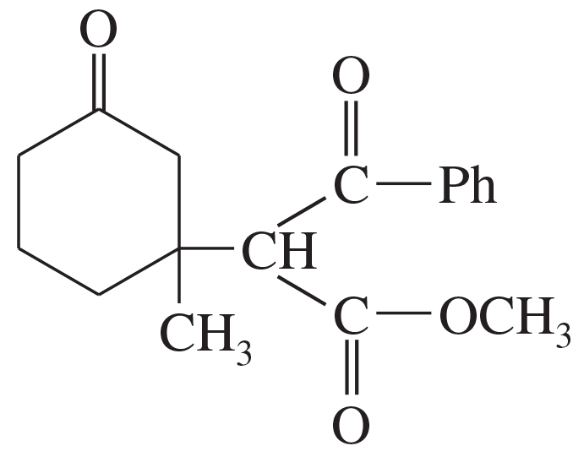

The following compounds can be synthesized by aldol condensations, followed by further reactions. (In each case, work backward from the target molecule to an aldol product, and show what compounds are needed for the condensation.) (b)
Verified step by step guidance
1
Step 1: Analyze the target molecule. The given compound contains a β-hydroxy ketone structure, which is characteristic of an aldol condensation product. Additionally, it has a phenyl group (Ph) attached to one of the carbonyl carbons, indicating the involvement of an aromatic aldehyde in the reaction.
Step 2: Work backward to identify the aldol product. The target molecule suggests that the aldol condensation involved a cyclopentanone (as the ketone component) and benzaldehyde (as the aldehyde component). The β-hydroxy ketone intermediate would have formed before dehydration.
Step 3: Determine the starting materials. The aldol condensation requires an enolate ion formed from cyclopentanone and benzaldehyde as the electrophilic aldehyde. The enolate attacks the carbonyl carbon of benzaldehyde, forming the β-hydroxy ketone intermediate.
Step 4: Consider the dehydration step. After the aldol addition, the β-hydroxy ketone undergoes dehydration (loss of water) to form the α,β-unsaturated ketone. This step is typically acid- or base-catalyzed.
Step 5: Verify the synthesis pathway. The reaction sequence involves: (1) enolate formation from cyclopentanone, (2) nucleophilic attack on benzaldehyde, (3) formation of the β-hydroxy ketone intermediate, and (4) dehydration to yield the final product. Ensure the reaction conditions are appropriate for each step.
Verified video answer for a similar problem:
This video solution was recommended by our tutors as helpful for the problem above
Video duration:
7m
Play a video:
Was this helpful?
Key Concepts
Here are the essential concepts you must grasp in order to answer the question correctly.
Aldol Condensation
Aldol condensation is a fundamental reaction in organic chemistry where two aldehydes or ketones react in the presence of a base to form a β-hydroxy aldehyde or ketone, which can further dehydrate to yield an α,β-unsaturated carbonyl compound. This reaction is crucial for building complex molecules and is often used in synthetic pathways to create larger carbon frameworks.
Retrosynthetic analysis is a problem-solving technique used in organic synthesis where the target molecule is deconstructed into simpler precursor structures. This approach helps chemists identify the necessary starting materials and reactions needed to synthesize a desired compound, facilitating the planning of synthetic routes in a logical manner.
Functional groups are specific groups of atoms within molecules that are responsible for the characteristic chemical reactions of those molecules. Understanding functional groups, such as carbonyls and phenyl groups in the provided compound, is essential for predicting reactivity and guiding the synthesis of organic compounds through various reactions, including aldol condensation.