
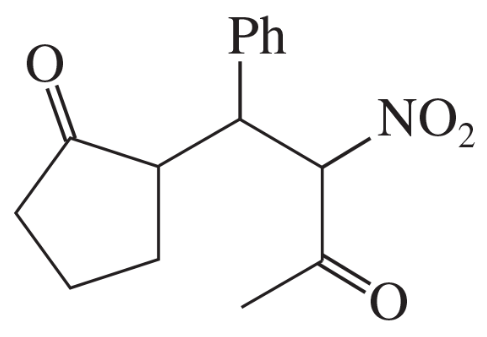

The following compounds can be synthesized by aldol condensations, followed by further reactions. (In each case, work backward from the target molecule to an aldol product, and show what compounds are needed for the condensation.) (c)
Verified step by step guidance
1
Step 1: Analyze the target molecule. The given compound contains a ketone group, a cyano group (-CN), and an α,β-unsaturated carbonyl system. This suggests that the molecule was likely formed through an aldol condensation followed by dehydration.
Step 2: Work backward to identify the aldol product. The α,β-unsaturated carbonyl system indicates that the molecule underwent dehydration after the aldol addition. To reverse this, break the double bond between the α and β carbons to identify the precursor aldol product.
Step 3: Determine the starting materials for the aldol condensation. The aldol product would have been formed by the reaction of two carbonyl compounds. One of these is likely a ketone (from the cyclic ketone in the target molecule), and the other is likely an aldehyde or ketone containing the cyano group.
Step 4: Propose the two reactants. The cyclic ketone (cyclohexanone) would act as the nucleophile, and the electrophile would be a molecule containing both a carbonyl group and a cyano group, such as 2-cyanoacetone.
Step 5: Describe the aldol condensation mechanism. The enolate ion formed from cyclohexanone would attack the carbonyl carbon of 2-cyanoacetone, forming a β-hydroxyketone intermediate. This intermediate would then undergo dehydration to yield the α,β-unsaturated carbonyl system in the target molecule.
Verified video answer for a similar problem:
This video solution was recommended by our tutors as helpful for the problem above
Video duration:
7m
Play a video:
Was this helpful?
Key Concepts
Here are the essential concepts you must grasp in order to answer the question correctly.
Aldol Condensation
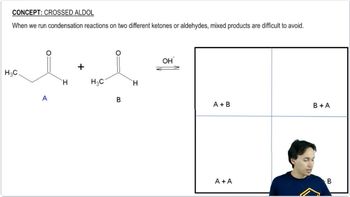
Aldol condensation is a fundamental reaction in organic chemistry where two aldehydes or ketones react in the presence of a base to form a β-hydroxy aldehyde or ketone, which can further dehydrate to yield an α,β-unsaturated carbonyl compound. This reaction is crucial for forming carbon-carbon bonds and is often used in the synthesis of complex organic molecules.
Retrosynthetic analysis is a problem-solving technique used in organic chemistry to deconstruct a target molecule into simpler precursor structures. By working backward from the desired product, chemists can identify the necessary starting materials and the reactions required to synthesize the target compound, facilitating the planning of synthetic routes.
Functional groups are specific groups of atoms within molecules that are responsible for the characteristic chemical reactions of those molecules. Understanding functional groups, such as carbonyls, amines, and hydroxyls, is essential for predicting the behavior of organic compounds during reactions, including aldol condensations and subsequent transformations.