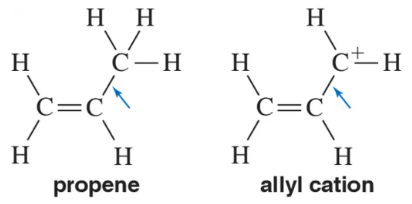
In propene, the indicated C―C bond length is 1.51 Å. In the allyl cation, the indicated C―C bond length is 1.41 Å. Explain.
Verified step by step guidance
1
In propene, the indicated C―C bond is a single bond between a sp3-hybridized carbon and a sp2-hybridized carbon. Single bonds typically have longer bond lengths due to less overlap of orbitals. The bond length is measured as 1.51 Å.
In the allyl cation, the indicated C―C bond is part of a conjugated system where resonance occurs. Resonance allows delocalization of electrons across the π-system, leading to partial double bond character in the indicated C―C bond.
Double bonds are shorter than single bonds because they involve greater orbital overlap (π and σ bonds). The delocalization in the allyl cation reduces the bond length to 1.41 Å, giving it a bond length closer to that of a double bond.
The allyl cation is stabilized by resonance, which distributes the positive charge over the molecule. This delocalization affects the bond lengths, making them intermediate between single and double bonds.
In summary, the shorter bond length in the allyl cation compared to propene is due to resonance and partial double bond character, while the longer bond length in propene is due to the single bond nature of the indicated C―C bond.
Was this helpful?
Key Concepts
Here are the essential concepts you must grasp in order to answer the question correctly.
Bond Length and Strength
Bond length refers to the distance between the nuclei of two bonded atoms. Generally, shorter bond lengths indicate stronger bonds due to increased overlap of atomic orbitals. In the case of propene and the allyl cation, the C―C bond in the allyl cation is shorter, suggesting a stronger bond compared to the C―C bond in propene.
Resonance stabilization occurs when a molecule can be represented by multiple valid Lewis structures, leading to a delocalization of electrons. In the allyl cation, the positive charge can be delocalized over the adjacent carbon atoms, which stabilizes the cation and results in a shorter C―C bond length due to increased bond strength from this electron delocalization.
Hybridization is the concept of mixing atomic orbitals to form new hybrid orbitals that can accommodate bonding. In propene, the carbon atoms are sp² hybridized, while in the allyl cation, the positive charge leads to a change in hybridization that can affect bond lengths. The sp² hybridization in propene allows for a longer bond length compared to the more effective overlap in the allyl cation, resulting in a shorter bond length.