Rank the following alkyl halides from most reactive to least reactive in an SN1 reaction: 2-bromo-2-methylpentane, 2-chloro-2-methylpentane, 3-chloropentane, and 2-iodo-2-methylpentane.
Verified step by step guidance
1
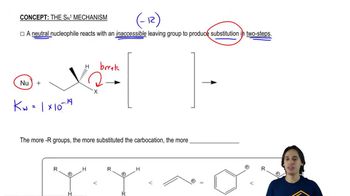
Step 1: Recall the key factors that influence the reactivity of alkyl halides in an SN1 reaction. The SN1 mechanism involves the formation of a carbocation intermediate, so the stability of the carbocation is a critical factor. Additionally, the leaving group ability plays a significant role in determining the reaction rate.
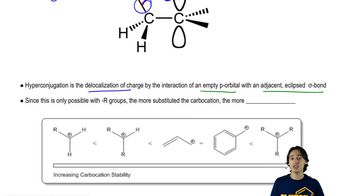
Step 2: Analyze the carbocation stability for each alkyl halide. The carbocation formed from 2-bromo-2-methylpentane, 2-chloro-2-methylpentane, and 2-iodo-2-methylpentane will be tertiary (due to the carbon attached to three alkyl groups), which is more stable than the secondary carbocation formed from 3-chloropentane. Therefore, the tertiary alkyl halides will generally react faster in an SN1 reaction than the secondary alkyl halide.
Step 3: Evaluate the leaving group ability of each halogen. The leaving group ability increases in the order: Cl⁻ < Br⁻ < I⁻. This means that 2-iodo-2-methylpentane will have the best leaving group, followed by 2-bromo-2-methylpentane, and then 2-chloro-2-methylpentane. 3-chloropentane, with a chlorine leaving group, will have the weakest leaving group among the options.
Step 4: Combine the effects of carbocation stability and leaving group ability. Since 2-iodo-2-methylpentane has both a tertiary carbocation and the best leaving group, it will be the most reactive. 2-bromo-2-methylpentane, with a tertiary carbocation and a good leaving group, will be the next most reactive. 2-chloro-2-methylpentane, with a tertiary carbocation but a weaker leaving group, will follow. Finally, 3-chloropentane, with a secondary carbocation and a weak leaving group, will be the least reactive.
Step 5: Rank the alkyl halides in order of reactivity for an SN1 reaction: 2-iodo-2-methylpentane > 2-bromo-2-methylpentane > 2-chloro-2-methylpentane > 3-chloropentane.
Verified video answer for a similar problem:
This video solution was recommended by our tutors as helpful for the problem above
Video duration:
6m
Play a video:
Was this helpful?
Key Concepts
Here are the essential concepts you must grasp in order to answer the question correctly.
SN1 Reaction Mechanism
The SN1 (Substitution Nucleophilic Unimolecular) reaction mechanism involves two main steps: the formation of a carbocation intermediate and the subsequent nucleophilic attack. The rate of the reaction depends solely on the concentration of the alkyl halide, making it unimolecular. This mechanism is favored in tertiary and some secondary alkyl halides due to their ability to stabilize the carbocation formed during the reaction.
Carbocation stability is a crucial factor in determining the reactivity of alkyl halides in SN1 reactions. Tertiary carbocations are more stable than secondary, which are more stable than primary due to hyperconjugation and inductive effects. The more stable the carbocation, the faster the reaction will proceed, as the formation of the carbocation is the rate-determining step in the SN1 mechanism.
The ability of a leaving group to depart from the substrate is essential in determining the reactivity of alkyl halides in SN1 reactions. Iodine is a better leaving group than bromine, which is better than chlorine, due to the bond strength and the stability of the leaving group after departure. Thus, alkyl halides with better leaving groups will generally react more quickly in SN1 reactions.