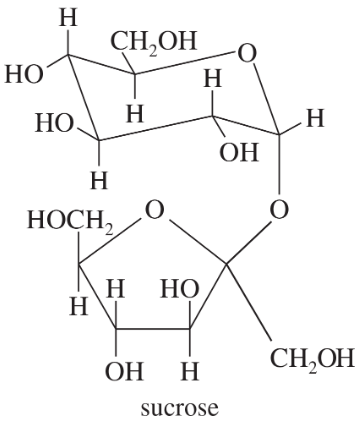
Which of the following are reducing sugars? Comment on the common name sucrose for table sugar. (e) (f)
Verified step by step guidance
1
Step 1: Analyze the chemical structures provided in the images. The first image shows a disaccharide with glycosidic bonds, and the second image is labeled as sucrose, which is also a disaccharide.
Step 2: Determine whether the sugars are reducing or non-reducing. A reducing sugar must have a free anomeric carbon (a carbon attached to the oxygen in the hemiacetal or hemiketal form) that can open up to form an aldehyde or ketone group. In sucrose, both anomeric carbons are involved in the glycosidic bond, preventing the sugar from acting as a reducing sugar.
Step 3: Comment on the common name 'sucrose' for table sugar. Sucrose is widely known as table sugar and is a non-reducing sugar due to the absence of a free anomeric carbon. It is composed of glucose and fructose linked by an α-1,2-glycosidic bond.
Step 4: Compare sucrose with other disaccharides like maltose or lactose, which are reducing sugars because they have a free anomeric carbon capable of undergoing oxidation.
Step 5: Conclude that sucrose is a non-reducing sugar and explain its significance in food and biochemistry, emphasizing its stability and inability to participate in reducing reactions like Benedict's test.
Verified video answer for a similar problem:
This video solution was recommended by our tutors as helpful for the problem above
Video duration:
7m
Play a video:
0 Comments
Key Concepts
Here are the essential concepts you must grasp in order to answer the question correctly.
Reducing Sugars
Reducing sugars are carbohydrates that can donate electrons to other molecules, typically due to the presence of a free aldehyde or ketone group. Common examples include glucose and fructose, which can reduce certain chemical reagents. In contrast, sucrose, which is a disaccharide composed of glucose and fructose, does not have a free aldehyde or ketone group in its structure, making it a non-reducing sugar.
Sucrose, commonly known as table sugar, is a disaccharide formed from the linkage of glucose and fructose through a glycosidic bond. This bond involves the anomeric carbon of glucose and the hydroxyl group of fructose, resulting in a molecule that lacks a free aldehyde or ketone group. Consequently, sucrose does not exhibit reducing properties, distinguishing it from other sugars that can participate in redox reactions.
Glycosidic Bond
A glycosidic bond is a type of covalent bond that connects a carbohydrate (sugar) molecule to another group, which can be another carbohydrate or a different type of molecule. In the case of sucrose, the glycosidic bond forms between the anomeric carbon of glucose and the hydroxyl group of fructose. This bond is crucial for the formation of disaccharides and polysaccharides, influencing their chemical properties and biological functions.


 7:27 minutes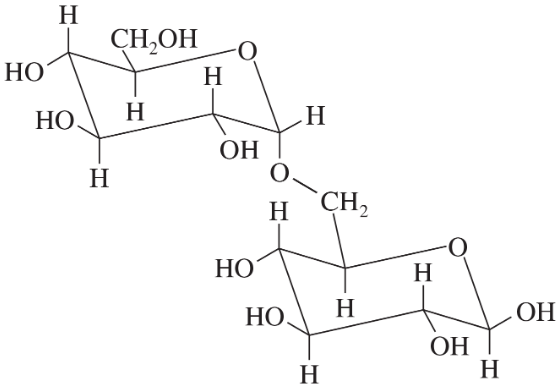
 Verified step by step guidance
 08:42
08:42