When the gum of the shrub Sterculia setigera is subjected to acidic hydrolysis, one of the water-soluble components of the hydrolysate is found to be tagatose. The following information is known about tagatose: (1) Molecular formula C6H12O6 (2) Undergoes mutarotation. (3) Does not react with bromine water. (4) Reduces Tollens reagent to give D-galactonic acid and D-talonic acid. (5) Methylation of tagatose (using excess CH3I and Ag2O) followed by acidic hydrolysis gives 1,3,4,5-tetra-O-methyltagatose. (a) Draw a Fischer projection structure for the open-chain form of tagatose.
Verified step by step guidance
1
Step 1: Analyze the molecular formula (C6H12O6) and determine that tagatose is a hexose (a six-carbon sugar) with the general formula of a carbohydrate (CnH2nOn). This indicates it is a monosaccharide.
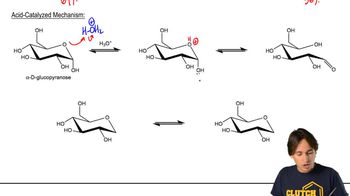
Step 2: Note that tagatose undergoes mutarotation, which implies it is a reducing sugar and exists in equilibrium between its open-chain form and cyclic forms (α and β anomers). This also suggests the presence of a free aldehyde or ketone group in the open-chain form.
Step 3: Observe that tagatose does not react with bromine water. Bromine water selectively oxidizes aldehydes to carboxylic acids, so the lack of reaction indicates that tagatose is a ketose (contains a ketone group rather than an aldehyde group).
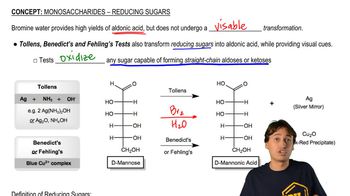
Step 4: Consider the reduction of Tollens reagent to form d-galactonic acid and d-talonic acid. This indicates that tagatose is a reducing sugar and can tautomerize to form an aldehyde group in its open-chain form, which reacts with Tollens reagent.
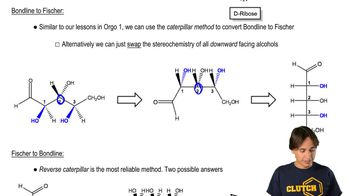
Step 5: Use the information from methylation (1,3,4,5-tetra-O-methyltagatose) to deduce the hydroxyl group positions. Combine this with the stereochemistry of d-galactose and d-tagatose to draw the Fischer projection of the open-chain form of tagatose, ensuring the ketone group is at C2 and the stereochemistry matches the given data.
Verified video answer for a similar problem:
This video solution was recommended by our tutors as helpful for the problem above
Video duration:
3m
Play a video:
Was this helpful?
Key Concepts
Here are the essential concepts you must grasp in order to answer the question correctly.
Fischer Projection
The Fischer projection is a two-dimensional representation of a molecule that shows the configuration of its stereocenters. In this format, the vertical lines represent bonds that are oriented away from the viewer, while horizontal lines represent bonds that are coming towards the viewer. This method is particularly useful for visualizing carbohydrates, as it allows for easy identification of the orientation of hydroxyl groups and the anomeric carbon in sugars.
Mutarotation is the change in optical rotation that occurs when an α-anomer and a β-anomer of a sugar interconvert in solution. This process is significant for sugars like tagatose, as it indicates the presence of an anomeric carbon that can exist in two different configurations. The ability to undergo mutarotation is a key characteristic of reducing sugars, which can affect their reactivity and interactions in biochemical processes.
Reducing sugars are carbohydrates that can donate electrons to other molecules, typically due to the presence of a free aldehyde or ketone group. In the case of tagatose, its ability to reduce Tollens reagent demonstrates its reducing properties, which are crucial for various chemical reactions. Understanding the reactivity of reducing sugars is essential for predicting their behavior in organic reactions and their role in metabolic pathways.