Propose a synthesis of the carbonyl(s) using the (ii) dihydroxylation/periodic acid cleavage pathways. (a)
Verified step by step guidance
1
Identify the starting alkene that can be used for dihydroxylation. The alkene should be chosen such that the resulting diol can be cleaved to form the desired carbonyl compounds.
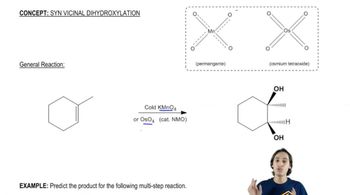
Perform dihydroxylation on the alkene. This can be achieved using reagents like osmium tetroxide (OsO₄) or potassium permanganate (KMnO₄) to convert the alkene into a vicinal diol.
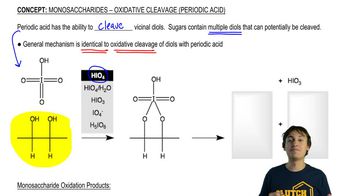
Once the diol is formed, use periodic acid (HIO₄) to cleave the diol. Periodic acid cleaves the C-C bond between the two hydroxyl groups, resulting in the formation of two carbonyl compounds.
Analyze the structure of the resulting carbonyl compounds to ensure they match the desired target molecules. Adjust the starting alkene if necessary to achieve the correct carbonyl products.
Consider any stereochemical implications of the dihydroxylation step, as the formation of syn-diols can affect the stereochemistry of the final carbonyl products.
Verified video answer for a similar problem:
This video solution was recommended by our tutors as helpful for the problem above
Video duration:
9m
Play a video:
Was this helpful?
Key Concepts
Here are the essential concepts you must grasp in order to answer the question correctly.
Dihydroxylation
Dihydroxylation is a chemical reaction that involves the addition of two hydroxyl groups (OH) across a double bond in an alkene, converting it into a vicinal diol. This reaction is typically carried out using reagents like osmium tetroxide (OsO4) or potassium permanganate (KMnO4). The process is stereospecific, often resulting in syn addition, where both hydroxyl groups add to the same side of the double bond.
General properties of syn vicinal dihydroxylation.
Periodic Acid Cleavage
Periodic acid cleavage is a reaction where vicinal diols are cleaved by periodic acid (HIO4) to form two carbonyl compounds, such as aldehydes or ketones. This reaction is useful for breaking down complex molecules into simpler carbonyl fragments. The mechanism involves the formation of a cyclic periodate ester, which then decomposes to yield the carbonyl products.
Carbonyl compounds are organic molecules that contain a carbon-oxygen double bond (C=O), such as aldehydes and ketones. These compounds are highly reactive due to the polar nature of the carbonyl group, making them key intermediates in various organic synthesis reactions. Understanding their reactivity and the types of reactions they undergo is crucial for designing synthetic pathways in organic chemistry.