Show the ketones that would result from hydrolysis and decarboxylation of the following β-keto esters.
Verified step by step guidance
1
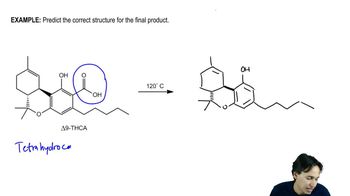
Step 1: Understand the reaction mechanism. Hydrolysis of β-keto esters involves breaking the ester bond in the presence of water and acid/base, forming a β-keto acid. Decarboxylation then removes the carboxyl group as CO₂, leaving behind a ketone.
Step 2: Analyze structure (a). The β-keto ester contains a phenyl group (PhCH₂), a methyl group (CH₃), and an ethyl ester group (COOC₂H₅). Hydrolysis will convert the ester group into a carboxylic acid, and decarboxylation will remove the carboxyl group, leaving a ketone with the phenyl and methyl groups attached to the central carbon.
Step 3: Analyze structure (b). The β-keto ester contains a cyclobutane ring, a methyl group (CH₃), and an ethyl ester group (COOCH₂CH₃). Hydrolysis will convert the ester group into a carboxylic acid, and decarboxylation will remove the carboxyl group, leaving a ketone with the cyclobutane ring and methyl group attached to the central carbon.
Step 4: Analyze structure (c). The β-keto ester contains a cyclopentanone ring and an ethyl ester group (OCH₂CH₃). Hydrolysis will convert the ester group into a carboxylic acid, and decarboxylation will remove the carboxyl group, leaving a ketone with the cyclopentanone ring intact.
Step 5: Summarize the results. For each β-keto ester, the hydrolysis and decarboxylation reactions yield a ketone. The specific ketone depends on the substituents attached to the β-keto ester structure. Ensure you understand how the ester group is hydrolyzed and how the carboxyl group is removed during decarboxylation.
Verified video answer for a similar problem:
This video solution was recommended by our tutors as helpful for the problem above
Video duration:
3m
Play a video:
Was this helpful?
Key Concepts
Here are the essential concepts you must grasp in order to answer the question correctly.
β-Keto Esters
β-keto esters are organic compounds that contain both a ketone and an ester functional group, with the carbonyl of the ketone located at the β position relative to the ester group. This structure allows for unique reactivity, particularly in reactions involving hydrolysis and decarboxylation, which can lead to the formation of ketones. Understanding the structure and reactivity of β-keto esters is crucial for predicting the products of these reactions.
Hydrolysis is a chemical reaction involving the breakdown of a compound by water, often resulting in the formation of an alcohol and a carboxylic acid from esters. In the context of β-keto esters, hydrolysis can lead to the release of the ketone and the corresponding carboxylic acid. This reaction is typically catalyzed by acids or bases and is essential for understanding how β-keto esters can be transformed into simpler ketones.
Decarboxylation is the process of removing a carboxyl group from a molecule, releasing carbon dioxide (CO2). In the case of β-keto esters, after hydrolysis, the resulting carboxylic acid can undergo decarboxylation, leading to the formation of a ketone. This reaction is significant in organic synthesis as it allows for the generation of ketones from β-keto esters, which are valuable intermediates in various chemical processes.