Draw the electrophoretic separation of Ala, Lys, and Asp at pH 9.7.
Verified step by step guidance
1
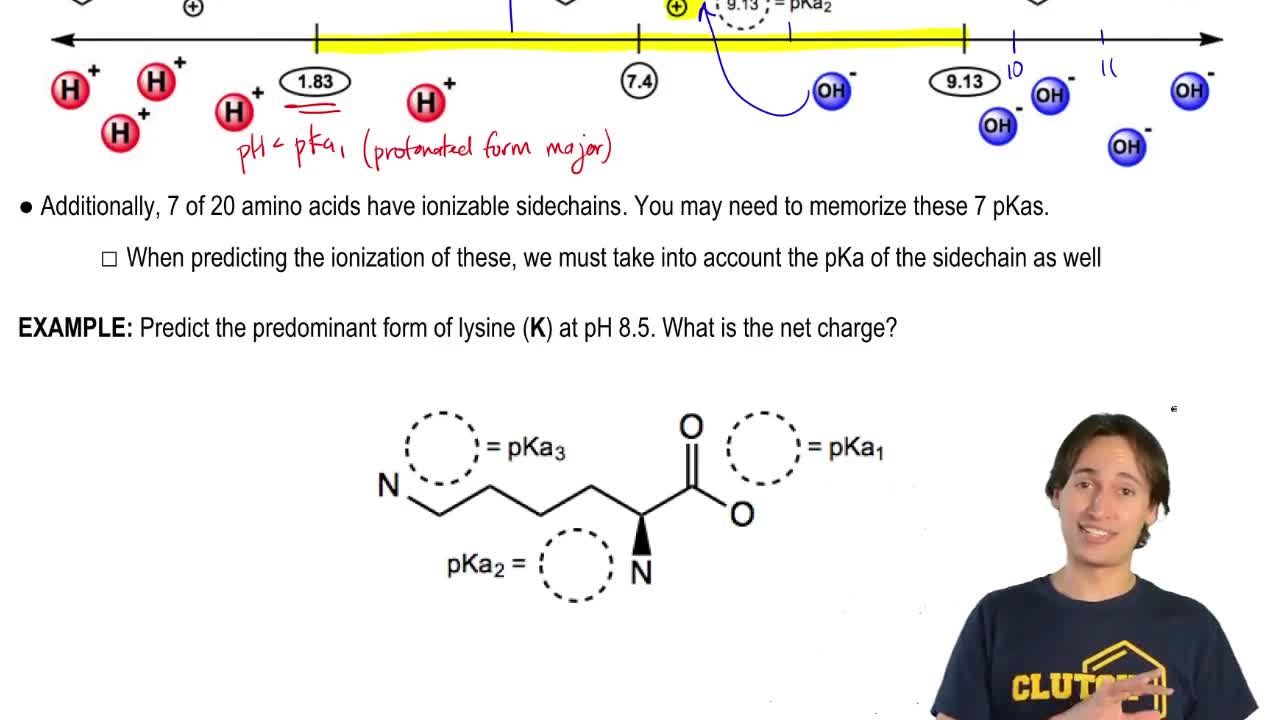
Determine the pKa values of the functional groups in each amino acid (Ala, Lys, and Asp). For Ala, consider the amino group (pKa ~9.7) and carboxyl group (pKa ~2.3). For Lys, include the amino group (pKa ~9.7), carboxyl group (pKa ~2.2), and side-chain amino group (pKa ~10.5). For Asp, include the amino group (pKa ~9.7), carboxyl group (pKa ~2.1), and side-chain carboxyl group (pKa ~3.9).
Evaluate the net charge of each amino acid at pH 9.7. Compare the pH to the pKa values of each functional group to determine whether each group is protonated or deprotonated. For example, if pH > pKa, the group is deprotonated; if pH < pKa, the group is protonated.
Assign the overall charge to each amino acid based on the protonation states of its functional groups. For instance, at pH 9.7, the amino group of Ala will be neutral, and the carboxyl group will be negatively charged, resulting in a net charge of -1. Repeat this process for Lys and Asp.
Predict the direction of migration for each amino acid during electrophoresis at pH 9.7. Amino acids with a net negative charge will migrate toward the anode (positive electrode), while those with a net positive charge will migrate toward the cathode (negative electrode). Neutral amino acids will not migrate significantly.
Draw the electrophoretic separation by placing Ala, Lys, and Asp on a diagram. Indicate their starting positions and the direction of their migration based on their net charges. Label the anode and cathode to show the orientation of the electric field.
Verified video answer for a similar problem:
This video solution was recommended by our tutors as helpful for the problem above
Video duration:
2m
Play a video:
0 Comments
Key Concepts
Here are the essential concepts you must grasp in order to answer the question correctly.
Isoelectric Point (pI)
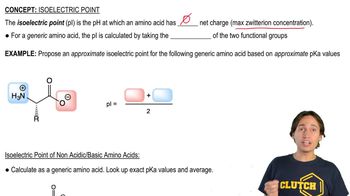
The isoelectric point (pI) is the pH at which a molecule, such as an amino acid, carries no net electrical charge. For amino acids, this is crucial because it determines their solubility and behavior in an electric field. At pH values below their pI, amino acids are positively charged, while at pH values above their pI, they are negatively charged.
Electrophoresis is a technique used to separate charged particles, such as amino acids, based on their size and charge under an electric field. When an electric current is applied, molecules migrate towards the electrode of opposite charge. The rate of migration depends on the charge-to-mass ratio of the molecules, allowing for their separation in a gel or solution.
Amino Acid Properties
Amino acids have unique side chains that influence their charge at different pH levels. For instance, at pH 9.7, the amino acid alanine (Ala) is neutral, lysine (Lys) is positively charged due to its basic side chain, and aspartic acid (Asp) is negatively charged because of its acidic side chain. Understanding these properties is essential for predicting their behavior during electrophoresis.