Give the IUPAC name and (if possible) a common name for each compound. (a)
Verified step by step guidance
1
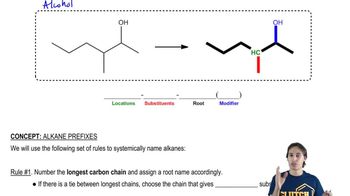
Step 1: Identify the longest continuous carbon chain in the molecule. This chain will serve as the parent chain for naming the compound. Count the number of carbons in this chain to determine the base name (e.g., propane, butane, pentane, etc.).
Step 2: Locate and identify the functional groups attached to the parent chain. In this molecule, there is a hydroxyl (-OH) group and a ketone (C=O) group. Determine their positions by numbering the carbon atoms in the parent chain, starting from the end closest to the functional group with the highest priority.
Step 3: Assign priority to the functional groups based on IUPAC rules. The ketone group (C=O) has higher priority than the hydroxyl group (-OH). Therefore, the numbering of the chain should prioritize the ketone group.
Step 4: Name the compound by combining the base name of the parent chain with the suffix for the ketone (-one) and the prefix for the hydroxyl group (hydroxy-). Include the position numbers for each functional group in the name.
Step 5: If applicable, provide a common name for the compound. Common names are often derived from traditional naming conventions and may not follow strict IUPAC rules. For example, the compound might be referred to as a derivative of a simpler ketone or alcohol.
Verified video answer for a similar problem:
This video solution was recommended by our tutors as helpful for the problem above
Video duration:
2m
Play a video:
Was this helpful?
Key Concepts
Here are the essential concepts you must grasp in order to answer the question correctly.
IUPAC Nomenclature
IUPAC nomenclature is a systematic method for naming organic chemical compounds. It provides rules for identifying the structure of a compound based on its functional groups, carbon chain length, and branching. Understanding these rules is essential for accurately determining the IUPAC name of a compound, which includes identifying the longest carbon chain and the position of functional groups.
Functional groups are specific groups of atoms within molecules that are responsible for the characteristic chemical reactions of those molecules. In the given compound, the presence of both a hydroxyl group (-OH) and a carbonyl group (C=O) indicates that it is a ketone with an alcohol, which influences its reactivity and properties. Recognizing these functional groups is crucial for naming and understanding the compound's behavior.
Common names are informal names used in the chemical community that may not follow systematic naming rules, while IUPAC names are standardized and universally accepted. For many compounds, especially those with historical significance or widespread use, common names can be easier to remember. Understanding the difference between these naming conventions is important for accurately identifying and communicating about chemical substances.