


Ribonucleosides are not so easily hydrolyzed, requiring relatively strong acid. Using your mechanism for part (a), show why cytidine and adenosine (for example) are not so readily hydrolyzed. Explain why this stability is important for living organisms.
Verified step by step guidance
1
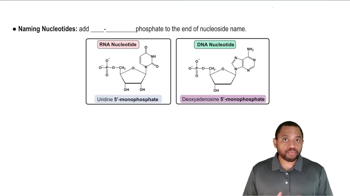
Identify the structure of ribonucleosides, such as cytidine and adenosine. These molecules consist of a ribose sugar linked to a nitrogenous base (cytosine or adenine) via a β-N-glycosidic bond.
Recall the mechanism for hydrolysis of glycosidic bonds. In acidic conditions, the hydrolysis typically involves protonation of the glycosidic oxygen, followed by cleavage of the bond to release the sugar and the base. This process is facilitated by the stability of the carbocation intermediate or transition state.
Analyze the electronic environment of the β-N-glycosidic bond in ribonucleosides. The nitrogen atom in the glycosidic bond is less electronegative than oxygen, making the bond less polarized and less susceptible to protonation. Additionally, the nitrogenous base does not stabilize a carbocation intermediate as effectively as oxygen in other glycosidic bonds (e.g., in DNA).
Explain why the resistance to hydrolysis is biologically significant. Ribonucleosides are components of RNA, which plays critical roles in protein synthesis and other cellular processes. Their stability ensures that RNA molecules remain intact under physiological conditions, allowing them to perform their functions effectively.
Conclude by emphasizing that the relatively strong acid required for hydrolysis of ribonucleosides reflects their chemical stability, which is essential for maintaining the integrity of genetic information and proper cellular function in living organisms.
Verified video answer for a similar problem:
This video solution was recommended by our tutors as helpful for the problem above
Video duration:
5m
Play a video:
Was this helpful?
Key Concepts
Here are the essential concepts you must grasp in order to answer the question correctly.
Nucleoside Structure
Nucleosides consist of a nitrogenous base linked to a sugar (ribose in the case of ribonucleosides). The glycosidic bond between the base and the sugar is crucial for the stability of the nucleoside. In cytidine and adenosine, the specific orientation and electronic properties of the substituents contribute to the strength of this bond, making hydrolysis less favorable under mild conditions.
The hydrolysis of nucleosides involves breaking the glycosidic bond, which can be facilitated by protonation in acidic conditions. However, ribonucleosides like cytidine and adenosine have structural features that stabilize the bond against protonation and subsequent cleavage. Understanding the role of pH and the stability of intermediates is essential for explaining their resistance to hydrolysis.
The stability of ribonucleosides is vital for cellular functions, as it ensures the integrity of RNA molecules during various biological processes. This stability prevents premature degradation, allowing for accurate protein synthesis and regulation of gene expression. In living organisms, maintaining the balance of nucleoside stability is crucial for proper cellular function and overall homeostasis.