
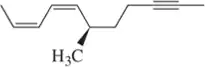
Name the following alkynes according to the IUPAC rules of nomenclature. (d)
Verified step by step guidance
1
Step 1: Identify the longest continuous carbon chain that includes both triple bonds (alkynes) and double bonds (alkenes). This will be the parent chain.
Step 2: Number the parent chain starting from the end closest to the first point of unsaturation (double or triple bond). Assign numbers to the carbons in the chain to minimize the locants for the double and triple bonds.
Step 3: Identify and name substituents attached to the parent chain. In this case, there is a methyl group attached to the chain.
Step 4: Combine the names of the substituents, the parent chain, and the locants for the double and triple bonds. Use the suffix '-yne' for triple bonds and '-ene' for double bonds, and indicate their positions in the chain.
Step 5: Ensure the name follows IUPAC rules, including proper placement of locants and alphabetical order for substituents. Double-check for stereochemistry if applicable.
Verified video answer for a similar problem:
This video solution was recommended by our tutors as helpful for the problem above
Play a video:
Was this helpful?
Key Concepts
Here are the essential concepts you must grasp in order to answer the question correctly.
IUPAC Nomenclature
The International Union of Pure and Applied Chemistry (IUPAC) nomenclature provides a systematic method for naming organic compounds. It involves identifying the longest carbon chain, determining the functional groups, and applying specific rules for naming based on the structure. For alkynes, which are hydrocarbons containing at least one triple bond, the suffix '-yne' is used, and the position of the triple bond is indicated by a number.
Alkynes are a class of unsaturated hydrocarbons characterized by the presence of one or more carbon-carbon triple bonds. They follow the general formula CnH2n-2, where 'n' is the number of carbon atoms. Alkynes can be linear or branched, and their reactivity is influenced by the triple bond, making them important in various chemical reactions and synthesis processes.
In IUPAC nomenclature, numbering the carbon chain is crucial for indicating the position of functional groups and multiple bonds. The carbon chain is numbered from the end closest to the first point of unsaturation, such as a triple bond in alkynes. This ensures that the lowest possible numbers are assigned to the substituents and functional groups, which is essential for clear and unambiguous naming.