Complete the structure of each of these so that it matches the (R) or (S) configuration associated with the name. (e)
Verified step by step guidance
1
Step 1: Understand the problem. The goal is to assign the correct stereochemistry (R or S configuration) to the chiral centers in the given molecule, 2-bromocyclopentan-1-ol, based on the (1R,2S) designation provided.
Step 2: Identify the chiral centers. In the given structure, the carbon attached to the OH group (C1) and the carbon attached to the Br group (C2) are chiral centers because they are bonded to four different groups.
Step 3: Assign priorities to the substituents on C1 (the carbon with the OH group) using the Cahn-Ingold-Prelog priority rules. The substituents are: OH (highest priority due to atomic number), the cyclopentane ring, the hydrogen (lowest priority), and the carbon attached to Br.
Step 4: Assign priorities to the substituents on C2 (the carbon with the Br group) using the same rules. The substituents are: Br (highest priority due to atomic number), the cyclopentane ring, the hydrogen (lowest priority), and the carbon attached to OH.
Step 5: Determine the spatial arrangement of the substituents around each chiral center. For C1, arrange the substituents in decreasing priority and determine if the rotation is clockwise (R) or counterclockwise (S). Repeat the process for C2. Ensure the final structure matches the (1R,2S) configuration as specified in the problem.
Verified video answer for a similar problem:
This video solution was recommended by our tutors as helpful for the problem above
Play a video:
Was this helpful?
Key Concepts
Here are the essential concepts you must grasp in order to answer the question correctly.
Stereochemistry
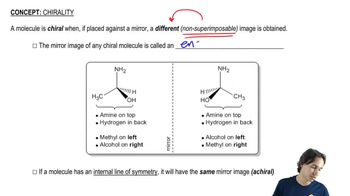
Stereochemistry is the study of the spatial arrangement of atoms in molecules and how this affects their chemical behavior. It is crucial for understanding isomerism, particularly enantiomers, which are molecules that are mirror images of each other. The (R) and (S) nomenclature is used to denote the configuration of chiral centers in a molecule, which is essential for determining the correct structure in organic compounds.
Chirality refers to the property of a molecule that makes it non-superimposable on its mirror image, much like left and right hands. A chiral center, typically a carbon atom, is bonded to four different substituents, leading to two distinct configurations. Understanding chirality is vital for predicting the behavior of molecules in biological systems, as different enantiomers can have vastly different effects.
The nomenclature of organic compounds follows specific rules set by the International Union of Pure and Applied Chemistry (IUPAC). This system provides a standardized way to name compounds based on their structure, functional groups, and stereochemistry. For example, in the name (1R,2S)-2-bromocyclopentan-1-ol, the numbers indicate the positions of substituents, while the R and S designations specify the stereochemistry at the chiral centers.