Step 1: Recall the criteria for aromaticity. A molecule is aromatic if it satisfies the following conditions: (1) It is cyclic, (2) It is planar, (3) It has a conjugated π-electron system (alternating single and double bonds), and (4) It follows Huckel's rule, which states that the molecule must have (4n + 2) π-electrons, where n is a non-negative integer.
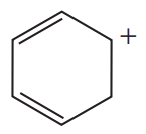
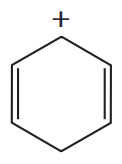
Step 2: Analyze structure A. Structure A is a cyclic molecule with alternating single and double bonds, indicating conjugation. It has a negative charge, which contributes two π-electrons to the system. Count the total π-electrons in the ring, including those from the double bonds and the negative charge, and check if it satisfies Huckel's rule.
Step 3: Analyze structure B. Structure B is a cyclic molecule with alternating single and double bonds, indicating conjugation. It has a positive charge, which removes one π-electron from the system. Count the total π-electrons in the ring, including those from the double bonds and the positive charge, and check if it satisfies Huckel's rule.
Step 4: Analyze structure C. Structure C is a cyclic molecule with alternating single and double bonds, indicating conjugation. Count the total π-electrons in the ring from the double bonds and check if it satisfies Huckel's rule.
Step 5: Compare the results for structures A, B, and C. Determine which structures satisfy all the criteria for aromaticity, including Huckel's rule, and identify them as aromatic.
Verified video answer for a similar problem:
This video solution was recommended by our tutors as helpful for the problem above
Video duration:
5m
Play a video:
Was this helpful?
Key Concepts
Here are the essential concepts you must grasp in order to answer the question correctly.
Aromaticity
Aromaticity is a property of cyclic compounds that exhibit enhanced stability due to the delocalization of π electrons across the ring. For a compound to be aromatic, it must be cyclic, planar, and follow Hückel's rule, which states that it should have 4n + 2 π electrons, where n is a non-negative integer.
Hückel's rule is a criterion used to determine if a planar, cyclic compound is aromatic. According to this rule, a compound is aromatic if it contains a total of 4n + 2 π electrons in its conjugated system, which leads to increased stability and unique chemical properties compared to non-aromatic compounds.
For a compound to be aromatic, it must be planar, allowing for effective overlap of p orbitals, which facilitates the delocalization of π electrons. Conjugation refers to the alternating single and double bonds that allow for this electron delocalization, contributing to the overall stability and reactivity of the aromatic system.