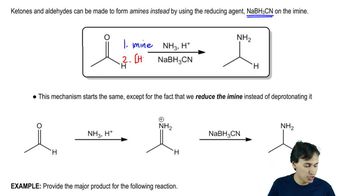
Show how you can synthesize the following compounds starting with benzene, toluene, and alcohols containing no more than four carbon atoms as your organic starting materials. Assume that para is the major product (and separable from ortho) in ortho, para mixtures. (d) N-benzylpropan-1-amine
Verified step by step guidance
1
Step 1: Start with toluene as the base compound. Toluene is benzene with a methyl group attached, which will serve as the starting point for the synthesis.
Step 2: Perform a Friedel-Crafts alkylation to introduce a propyl group onto the benzene ring. Use propyl chloride (CH₃CH₂CH₂Cl) and a Lewis acid catalyst such as AlCl₃. This will yield para-propyl toluene as the major product due to steric hindrance.
Step 3: Oxidize the methyl group on the benzene ring to a benzylic alcohol. Use a reagent like KMnO₄ under controlled conditions to convert the methyl group to a benzyl alcohol (-CH₂OH).
Step 4: Convert the benzyl alcohol to a benzylamine group (-CH₂NH₂). This can be achieved by first converting the alcohol to a benzyl halide (e.g., benzyl chloride) using SOCl₂ or PCl₃, followed by nucleophilic substitution with ammonia (NH₃).
Step 5: Combine the benzylamine with the propyl group to form N-benzylpropan-1-amine. This can be done by reacting the benzylamine with 1-bromopropane (CH₃CH₂CH₂Br) in the presence of a base like NaOH to facilitate the nucleophilic substitution reaction.
Verified video answer for a similar problem:
This video solution was recommended by our tutors as helpful for the problem above
Video duration:
8m
Play a video:
0 Comments
Key Concepts
Here are the essential concepts you must grasp in order to answer the question correctly.
Electrophilic Aromatic Substitution (EAS)
Electrophilic Aromatic Substitution is a fundamental reaction in organic chemistry where an electrophile replaces a hydrogen atom on an aromatic ring. This reaction is crucial for synthesizing various aromatic compounds, including those derived from benzene and toluene. Understanding the mechanism of EAS, including the role of activating and deactivating groups, is essential for predicting the products of reactions involving aromatic compounds.
N-Alkylation of amines involves the introduction of an alkyl group to the nitrogen atom of an amine, forming a substituted amine. This reaction is typically carried out using alkyl halides or other alkylating agents. In the context of synthesizing N-benzylpropan-1-amine, understanding how to effectively perform this reaction is vital, especially when considering regioselectivity and the potential for side reactions.
The conversion of alcohols to amines can be achieved through various methods, including reduction and substitution reactions. In this synthesis, alcohols can be transformed into amines via nucleophilic substitution or by using reagents that facilitate the formation of amines. Recognizing the appropriate conditions and reagents for these transformations is key to successfully synthesizing compounds like N-benzylpropan-1-amine from the specified starting materials.


 8:52 minutes
 Verified step by step guidance
 03:07
03:07