The two most general amine syntheses are the reductive amination of carbonyl compounds and the reduction of amides. Show how these techniques can be used to accomplish the following syntheses. (d) cyclohexanone → N-cyclohexylpyrrolidine
Verified step by step guidance
1
Identify the starting material (cyclohexanone) and the target product (N-cyclohexylpyrrolidine). Recognize that the transformation involves introducing a pyrrolidine group to the cyclohexane ring via an amine synthesis method.
Choose reductive amination as the appropriate method for this synthesis. Reductive amination involves reacting a carbonyl compound (cyclohexanone) with an amine (pyrrolidine) in the presence of a reducing agent to form the desired amine product.
Write the reaction mechanism: In the first step, cyclohexanone reacts with pyrrolidine to form an imine intermediate. This occurs through nucleophilic attack of the amine nitrogen on the carbonyl carbon, followed by the elimination of water.
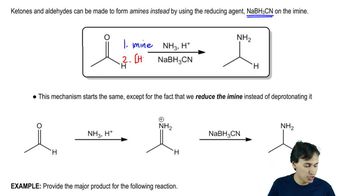
In the second step, the imine intermediate is reduced to the corresponding amine (N-cyclohexylpyrrolidine) using a reducing agent such as sodium cyanoborohydride (NaBH₃CN) or hydrogen gas with a metal catalyst (e.g., Pd/C).
Ensure proper reaction conditions: Use an appropriate solvent (e.g., ethanol or methanol) and maintain mild reaction conditions to facilitate the reductive amination process without side reactions. This will yield N-cyclohexylpyrrolidine as the final product.
Verified video answer for a similar problem:
This video solution was recommended by our tutors as helpful for the problem above
Video duration:
2m
Play a video:
0 Comments
Key Concepts
Here are the essential concepts you must grasp in order to answer the question correctly.
Reductive Amination
Reductive amination is a chemical reaction that involves the conversion of a carbonyl compound, such as an aldehyde or ketone, into an amine. This process typically involves the formation of an intermediate imine or enamine, which is then reduced to yield the amine. In the context of synthesizing N-cyclohexylpyrrolidine from cyclohexanone, this method allows for the introduction of the amine group through the reaction with an appropriate amine and subsequent reduction.
The reduction of amides is a method used to convert amides into amines. This process often involves the use of reducing agents such as lithium aluminum hydride (LiAlH4) or borane (BH3), which effectively add hydrogen to the carbonyl carbon of the amide, resulting in the formation of an amine. Understanding this concept is crucial for exploring alternative pathways to synthesize amines, including N-cyclohexylpyrrolidine.
Pyrrolidine is a five-membered saturated heterocyclic amine with the formula C4H9N. Its synthesis often involves the formation of a cyclic structure through the reaction of a suitable precursor, such as an amine and a carbonyl compound. In the case of synthesizing N-cyclohexylpyrrolidine, recognizing the structural features of pyrrolidine and the necessary reaction conditions is essential for successfully completing the synthesis from cyclohexanone.


 2:17 minutes
 Verified step by step guidance
 07:12
07:12