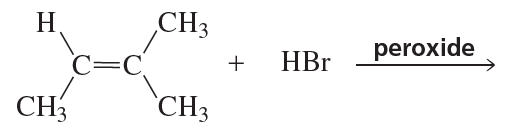
What alkyl halide will be obtained in greatest yield? Ignore stereoisomers. c.
Verified step by step guidance
1
Step 1: Recognize the reaction type. The presence of peroxide indicates that this is a free radical addition of HBr to an alkene, following the anti-Markovnikov rule. This means the bromine atom will add to the less substituted carbon of the double bond.
Step 2: Identify the structure of the alkene. The given alkene is 2-methyl-2-butene, which has a double bond between the second and third carbons.
Step 3: Determine the less substituted carbon in the double bond. In 2-methyl-2-butene, the less substituted carbon is the third carbon, as the second carbon is bonded to three other carbons.
Step 4: Predict the product. The bromine atom will add to the third carbon, and the hydrogen atom will add to the second carbon, resulting in the formation of 3-bromo-2-methylbutane.
Step 5: Confirm the major product. Since the reaction follows the anti-Markovnikov rule and stereoisomers are ignored, the major product will be 3-bromo-2-methylbutane.
Verified video answer for a similar problem:
This video solution was recommended by our tutors as helpful for the problem above
Video duration:
4m
Play a video:
Was this helpful?
Key Concepts
Here are the essential concepts you must grasp in order to answer the question correctly.
Anti-Markovnikov Addition
Anti-Markovnikov addition refers to the addition of HX (where X is a halogen) to alkenes in a manner that results in the halogen attaching to the less substituted carbon atom. This is typically facilitated by the presence of peroxides, which promote a radical mechanism, leading to the formation of the less stable radical intermediate and ultimately favoring the less substituted product.
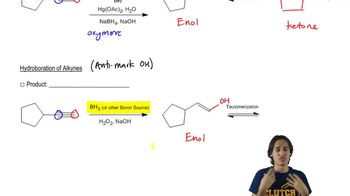
Anti-Markovnikov addition of alcohols to terminal alkynes yields aldehydes
Radical Mechanism
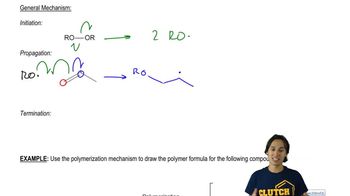
A radical mechanism involves the formation and reaction of free radicals, which are highly reactive species with unpaired electrons. In the context of alkene reactions with HBr in the presence of peroxides, the radical mechanism allows for the anti-Markovnikov addition by generating bromine radicals that add to the alkene, leading to the formation of the product with the bromine on the less substituted carbon.
Alkyl halides are organic compounds derived from alkanes that contain one or more halogen atoms (F, Cl, Br, I) replacing hydrogen atoms. The structure and substitution pattern of the alkyl halide influence its reactivity and stability, which is crucial when determining the yield of products in reactions involving alkenes and halogen acids, especially under radical conditions.