What five-carbon alkene forms the same product whether it reacts with HBr in the presence of a peroxide or with HBr in the absence of a peroxide?
Verified step by step guidance
1
Identify the key difference between the two reaction conditions: In the presence of a peroxide, the reaction follows the anti-Markovnikov rule (radical mechanism), while in the absence of a peroxide, the reaction follows the Markovnikov rule (ionic mechanism).
Understand that the product will be the same in both cases only if the addition of HBr to the alkene does not create regioisomers. This means the alkene must be symmetrical or structured such that both Markovnikov and anti-Markovnikov additions lead to the same product.
Consider the structure of five-carbon alkenes. A symmetrical alkene, such as 2-pentene, will produce the same product regardless of the reaction pathway because the addition of HBr will occur at equivalent positions on the double bond.
Analyze the mechanism for both conditions: In the absence of a peroxide, the H⁺ adds to the carbon with more hydrogens (Markovnikov rule), and in the presence of a peroxide, the Br• radical adds to the carbon with more hydrogens (anti-Markovnikov rule). For a symmetrical alkene like 2-pentene, both pathways lead to the same product.
Conclude that the five-carbon alkene that forms the same product under both conditions is a symmetrical alkene, such as 2-pentene, because its structure ensures identical outcomes regardless of the reaction mechanism.
Verified video answer for a similar problem:
This video solution was recommended by our tutors as helpful for the problem above
Video duration:
6m
Play a video:
Was this helpful?
Key Concepts
Here are the essential concepts you must grasp in order to answer the question correctly.
Markovnikov's Rule
Markovnikov's Rule states that when HX (where X is a halogen) adds to an alkene, the hydrogen atom will attach to the carbon with the greater number of hydrogen atoms already attached. This rule helps predict the major product of electrophilic addition reactions, particularly in the absence of peroxides.
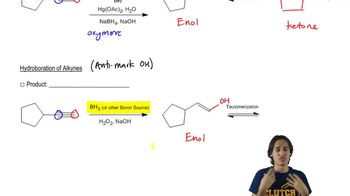
Anti-Markovnikov addition occurs when the addition of HX to an alkene results in the halogen attaching to the less substituted carbon. This is typically facilitated by the presence of peroxides, which lead to a radical mechanism that reverses the regioselectivity observed in standard electrophilic additions.
Anti-Markovnikov addition of alcohols to terminal alkynes yields aldehydes
Radical Mechanism
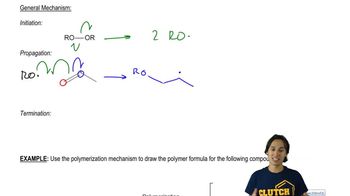
A radical mechanism involves the formation of free radicals during a chemical reaction. In the context of alkene reactions with HBr in the presence of peroxides, this mechanism allows for the anti-Markovnikov addition, where the bromine atom attaches to the less substituted carbon, leading to different product outcomes compared to the non-radical pathway.