What is the configuration of each of the asymmetric centers in the following compounds? a. b.
Verified step by step guidance
1
Step 1: Identify the asymmetric centers in each compound. An asymmetric center is a carbon atom bonded to four different groups. In compound (a), the central carbon is bonded to Br, OH, CH3, and H. In compound (b), the central carbon is bonded to Cl, CH3, CH2Cl, and H.
Step 2: Assign priorities to the substituents around the asymmetric center based on the Cahn-Ingold-Prelog (CIP) priority rules. The priority is determined by the atomic number of the atoms directly attached to the asymmetric center. For compound (a), the priorities are: Br (highest, atomic number 35), OH (atomic number 8), CH3 (atomic number 6), and H (lowest, atomic number 1). For compound (b), the priorities are: Cl (highest, atomic number 17), CH2Cl (atomic number 6 with Cl attached), CH3 (atomic number 6), and H (lowest, atomic number 1).
Step 3: Orient the molecule so that the lowest priority group (H) is pointing away from you. For compound (a), the H is already pointing away (on the dashed wedge). For compound (b), the H is on the horizontal bond, so you may need to mentally rotate the molecule to visualize it correctly.
Step 4: Determine the sequence of the remaining three groups (1, 2, 3) in order of priority. Trace the path from the highest priority group to the second and then to the third. For compound (a), trace from Br → OH → CH3. For compound (b), trace from Cl → CH2Cl → CH3.
Step 5: Assign the configuration as R or S based on the direction of the sequence. If the sequence is clockwise, the configuration is R. If the sequence is counterclockwise, the configuration is S. Use the orientation and priority sequence determined in the previous steps to assign the configuration for each compound.
Verified video answer for a similar problem:

This video solution was recommended by our tutors as helpful for the problem above
Video duration:
1m
Play a video:
Was this helpful?
Key Concepts
Here are the essential concepts you must grasp in order to answer the question correctly.
Asymmetric Centers
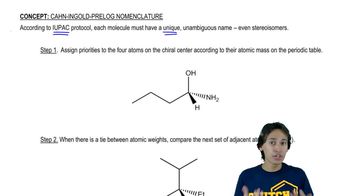
Asymmetric centers, or chiral centers, are carbon atoms bonded to four different substituents, leading to non-superimposable mirror images known as enantiomers. Identifying these centers is crucial for determining the stereochemistry of a compound, as the spatial arrangement of these substituents affects the compound's properties and reactivity.
The Cahn-Ingold-Prelog (CIP) priority rules are a systematic method for assigning priorities to the substituents attached to an asymmetric center. By comparing the atomic numbers of the atoms directly bonded to the chiral carbon, one can determine the order of priority, which is essential for assigning the R or S configuration to the chiral centers.
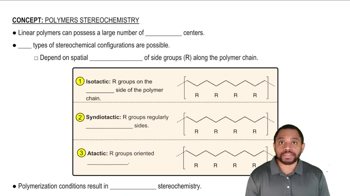
Stereochemistry is the study of the spatial arrangement of atoms in molecules and how this arrangement affects their chemical behavior. Understanding stereochemistry is vital for analyzing the configuration of asymmetric centers, as it influences the physical and biological properties of compounds, including their interactions with enzymes and receptors.