
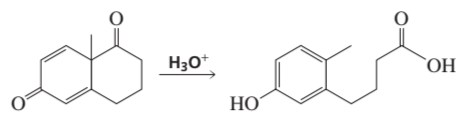
Propose a mechanism for each of the following reactions: b.
Verified step by step guidance
1
Step 1: Analyze the starting material and the product. The starting material is a cyclic diketone, and the product is a phenol with a carboxylic acid side chain. This suggests a ring-opening reaction followed by rearrangement under acidic conditions.
Step 2: Protonation of one of the carbonyl groups occurs first under acidic conditions (H3O+), making the carbonyl carbon more electrophilic and susceptible to nucleophilic attack.
Step 3: Water acts as a nucleophile and attacks the protonated carbonyl group, leading to the formation of a tetrahedral intermediate. This intermediate undergoes rearrangement to open the ring structure.
Step 4: The ring-opening leads to the formation of a linear intermediate. Subsequent proton transfers and tautomerization occur, converting one of the ketone groups into a hydroxyl group (phenol formation).
Step 5: The other carbonyl group undergoes hydrolysis to form a carboxylic acid. The final product is stabilized by resonance in the aromatic ring and the carboxylic acid group.
Verified video answer for a similar problem:
This video solution was recommended by our tutors as helpful for the problem above
Video duration:
3m
Play a video:
Was this helpful?
Key Concepts
Here are the essential concepts you must grasp in order to answer the question correctly.
Nucleophilic Acyl Substitution
Nucleophilic acyl substitution is a fundamental reaction in organic chemistry where a nucleophile attacks an acyl compound, leading to the replacement of a leaving group. In this mechanism, the nucleophile, often a water molecule in the presence of acid, attacks the carbonyl carbon, forming a tetrahedral intermediate. This intermediate then collapses, expelling the leaving group and forming a new carbonyl compound.
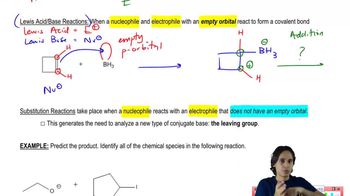
Nucleophiles and Electrophiles can react in Substitution Reactions.
Role of H3O+ in Acid-Catalyzed Reactions
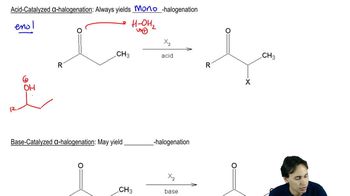
H3O+ (hydronium ion) acts as a catalyst in acid-catalyzed reactions, enhancing the electrophilicity of carbonyl compounds. In the context of nucleophilic acyl substitution, H3O+ protonates the carbonyl oxygen, increasing the positive charge on the carbonyl carbon and making it more susceptible to nucleophilic attack. This step is crucial for facilitating the reaction and ensuring a higher reaction rate.
The tetrahedral intermediate is a key species formed during nucleophilic acyl substitution. When the nucleophile attacks the carbonyl carbon, the sp2 hybridization of the carbon changes to sp3, resulting in a tetrahedral geometry. This intermediate is unstable and typically collapses to reform the carbonyl group, leading to the release of the leaving group and the formation of the final product.