
Draw a spectrum for each of the following molecules, being sure to indicate the multiplicity, integration, and chemical shift of each peak. Label each signal based on the set of equivalent hydrogens to which it corresponds. (c)
Verified step by step guidance
1
Identify the molecule structure and determine the number of unique hydrogen environments. Equivalent hydrogens will give rise to the same NMR signal.
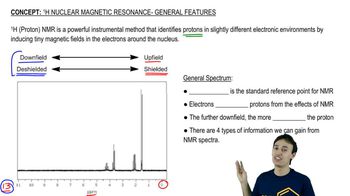
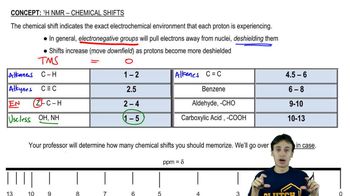
For each set of equivalent hydrogens, determine the chemical shift. Consider factors such as electronegativity of nearby atoms, hybridization, and aromaticity. Use reference tables or known chemical shift ranges for guidance.
Determine the multiplicity of each signal using the n+1 rule, where n is the number of neighboring hydrogens. This will help you identify if the signal is a singlet, doublet, triplet, etc.
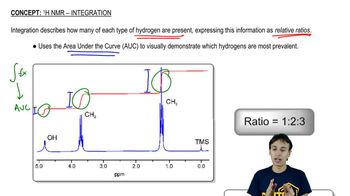
Calculate the integration of each signal, which corresponds to the number of hydrogens in each equivalent set. This is typically represented as the area under the peak in the spectrum.
Draw the spectrum, labeling each peak with its chemical shift, multiplicity, and integration. Ensure that each signal is clearly associated with the corresponding set of equivalent hydrogens in the molecule.
Verified video answer for a similar problem:
This video solution was recommended by our tutors as helpful for the problem above
Video duration:
2m
Play a video:
Was this helpful?
Key Concepts
Here are the essential concepts you must grasp in order to answer the question correctly.
NMR Spectroscopy
Nuclear Magnetic Resonance (NMR) Spectroscopy is a technique used to determine the structure of organic compounds by observing the behavior of nuclei in a magnetic field. It provides information about the number of chemically distinct hydrogen environments (protons) in a molecule, their chemical shifts, multiplicity, and integration, which are crucial for identifying molecular structure.
Chemical shift in NMR refers to the resonant frequency of a nucleus relative to a standard in a magnetic field. It is measured in parts per million (ppm) and provides insight into the electronic environment surrounding a nucleus. Different functional groups and bonding environments cause shifts in the resonance frequency, allowing for the identification of different types of hydrogen atoms in a molecule.
Multiplicity in NMR describes the splitting pattern of a signal, which results from spin-spin coupling between non-equivalent neighboring protons. It follows the n+1 rule, where n is the number of adjacent protons. Integration refers to the area under each NMR signal, which is proportional to the number of protons contributing to that signal, helping to determine the relative number of equivalent protons in different environments.