Textbook Question
Show how the following products might be synthesized from suitable Michael donors and acceptors.
(f)
597
views

 Wade 9th EditionCh. 22 - Condensations and Alpha Substitutions of Carbonyl CompoundsProblem 57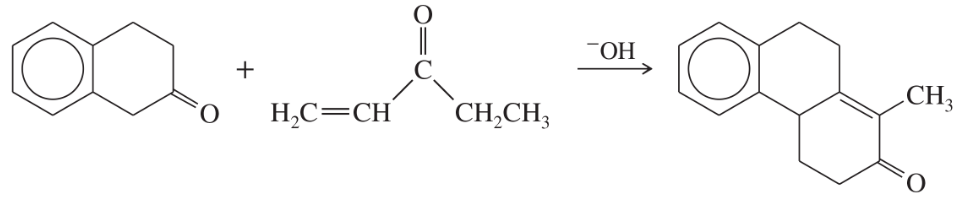
 Verified step by step guidance
 04:12
04:12
 09:23
09:23 09:51
09:51Show how the following products might be synthesized from suitable Michael donors and acceptors.
(f)
Show how the following products might be synthesized from suitable Michael donors and acceptors.
(e)
Show how you would use Robinson annulations to synthesize the following compounds. Work backward, remembering that the cyclohexenone is the new ring and that the double bond of the cyclohexenone is formed by the aldol with dehydration. Take apart the double bond, then see what structures the Michael donor and acceptor must have.
(a)
The base-catalyzed reaction of an aldehyde (having no α hydrogens) with an anhydride is called the Perkin condensation. Propose a mechanism for the following example of the Perkin condensation. (Sodium acetate serves as the base.)
Show how you would use Robinson annulations to synthesize the following compounds. Work backward, remembering that the cyclohexenone is the new ring and that the double bond of the cyclohexenone is formed by the aldol with dehydration. Take apart the double bond, then see what structures the Michael donor and acceptor must have.
(b)
Show how the following products might be synthesized from suitable Michael donors and acceptors.
(d)