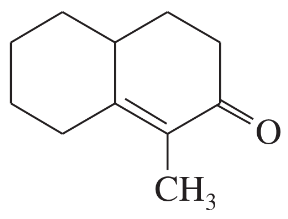
Show how you would use the Robinson annulation to synthesize the following compounds. (b)
Verified step by step guidance
1
Identify the target compound and determine the structural features that suggest it can be synthesized using the Robinson annulation. The Robinson annulation typically forms a six-membered ring through a Michael addition followed by an intramolecular aldol condensation.
Break down the target compound into its potential precursors. Look for a β-diketone or β-ketoester structure in the product, as this is a hallmark of the Robinson annulation. Identify the enolate donor and the α,β-unsaturated ketone (Michael acceptor) that could combine to form the target compound.
Propose the starting materials. The enolate donor is typically a ketone or β-ketoester, and the Michael acceptor is an α,β-unsaturated ketone. Ensure that the combination of these starting materials aligns with the structure of the target compound.
Outline the reaction mechanism: (1) The enolate of the ketone or β-ketoester attacks the α,β-unsaturated ketone in a Michael addition, forming a new carbon-carbon bond. (2) The resulting intermediate undergoes an intramolecular aldol condensation, where the enolate attacks a carbonyl group within the same molecule, forming a six-membered ring.
Verify the structure of the product. Ensure that the final compound matches the target compound, including the placement of functional groups and the stereochemistry, if applicable.
Verified video answer for a similar problem:
This video solution was recommended by our tutors as helpful for the problem above
Play a video:
Was this helpful?
Key Concepts
Here are the essential concepts you must grasp in order to answer the question correctly.
Robinson Annulation
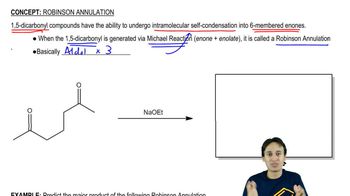
The Robinson annulation is a key synthetic method in organic chemistry that combines a Michael addition and an intramolecular aldol condensation. This reaction typically involves the formation of a six-membered ring, allowing for the construction of complex cyclic structures from simpler precursors. Understanding the mechanism and conditions required for this reaction is essential for effectively applying it in synthesis.
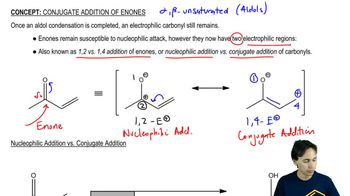
The Michael addition is a nucleophilic addition reaction where a nucleophile adds to an α,β-unsaturated carbonyl compound. This step is crucial in the Robinson annulation, as it forms a new carbon-carbon bond, setting the stage for subsequent reactions. Recognizing the reactivity of the unsaturated system and the nature of the nucleophile is vital for predicting the outcome of the synthesis.
Aldol condensation is a reaction between aldehydes or ketones that leads to the formation of β-hydroxy carbonyl compounds, which can further dehydrate to form α,β-unsaturated carbonyls. In the context of the Robinson annulation, this step is responsible for closing the ring and creating the final product. A solid grasp of the conditions that favor aldol reactions, such as base or acid catalysis, is important for successful synthesis.