Show how you can synthesize the following compounds starting with benzene, toluene, and alcohols containing no more than four carbon atoms as your organic starting materials. Assume that para is the major product (and separable from ortho) in ortho, para mixtures. (b) N-methylbutan-1-amine
Verified step by step guidance
1
Step 1: Start with butanol (an alcohol with four carbon atoms) as the starting material. Convert butanol to butanal using an oxidation reaction. This can be achieved using PCC (Pyridinium chlorochromate) as the oxidizing agent.
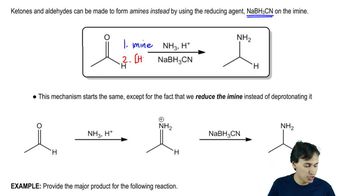
Step 2: Perform reductive amination of butanal to introduce the amine group. React butanal with methylamine (CH₃NH₂) in the presence of a reducing agent like sodium cyanoborohydride (NaBH₃CN). This will yield N-methylbutan-1-amine.
Step 3: Verify the structure of the product to ensure that the amine group is attached to the first carbon of the butane chain and that the methyl group is bonded to the nitrogen atom.
Step 4: Purify the product to separate it from any side products or unreacted starting materials. Techniques like distillation or recrystallization can be used depending on the physical properties of the product.
Step 5: Confirm the identity of the synthesized compound using spectroscopic methods such as IR (to check for the presence of the amine group) and NMR (to confirm the structure and verify the positions of the substituents).
Verified video answer for a similar problem:
This video solution was recommended by our tutors as helpful for the problem above
Video duration:
2m
Play a video:
Was this helpful?
Key Concepts
Here are the essential concepts you must grasp in order to answer the question correctly.
Electrophilic Aromatic Substitution
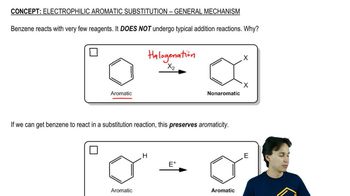
Electrophilic aromatic substitution (EAS) is a fundamental reaction in organic chemistry where an electrophile replaces a hydrogen atom on an aromatic ring. This process is crucial for synthesizing various compounds from benzene and its derivatives. Understanding the mechanism of EAS, including the formation of the sigma complex and the role of activating and deactivating groups, is essential for predicting the products of reactions involving benzene and toluene.
N-alkylation of amines involves the introduction of an alkyl group to the nitrogen atom of an amine, forming a substituted amine. This reaction can be achieved through various methods, including the use of alkyl halides or alcohols in the presence of a base. Understanding the reactivity of amines and the conditions required for successful alkylation is vital for synthesizing compounds like N-methylbutan-1-amine from simpler starting materials.
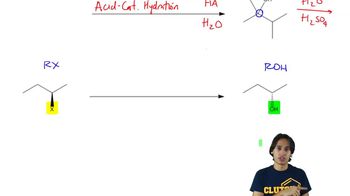
The conversion of alcohols to amines can be accomplished through several methods, including reductive amination or the use of reagents like thionyl chloride followed by amination. This transformation is significant in organic synthesis, particularly when starting from alcohols with a limited number of carbon atoms. Familiarity with these methods allows for the effective synthesis of amines, such as N-methylbutan-1-amine, from alcohols and other organic precursors.