Write equations showing the expected products of the following enamine alkylation and acylation reactions. Then give the final products expected after hydrolysis of the iminium salts. (d) piperidine enamine of cyclopentanone + methyl vinyl ketone
Verified step by step guidance
1
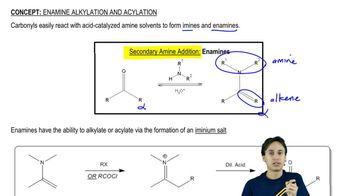
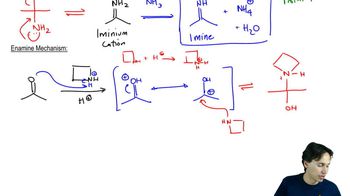
Step 1: Recognize the enamine structure. The piperidine enamine of cyclopentanone consists of a cyclopentanone ring with a double bond between the alpha-carbon and the nitrogen of the piperidine group. This enamine acts as a nucleophile in the reaction.
Step 2: Identify the electrophile. Methyl vinyl ketone (CH3-CH=CH-COCH3) is an alpha, beta-unsaturated ketone, which can undergo a Michael addition reaction with the enamine. The beta-carbon of the methyl vinyl ketone is the electrophilic site.
Step 3: Perform the Michael addition. The nucleophilic alpha-carbon of the enamine attacks the beta-carbon of the methyl vinyl ketone, forming a new carbon-carbon bond. This results in the formation of an intermediate iminium salt.
Step 4: Hydrolyze the iminium salt. The iminium salt formed in the previous step undergoes hydrolysis in the presence of water and an acid catalyst. This regenerates the original ketone group and removes the piperidine group, yielding the final product.
Step 5: Write the final product. The final product is a 1,5-diketone, where the cyclopentanone ring is now connected to the methyl vinyl ketone via a new carbon-carbon bond. Ensure the structure reflects the correct connectivity and functional groups.
Verified video answer for a similar problem:
This video solution was recommended by our tutors as helpful for the problem above
Video duration:
2m
Play a video:
0 Comments
Key Concepts
Here are the essential concepts you must grasp in order to answer the question correctly.
Enamines
Enamines are derivatives of carbonyl compounds formed by the reaction of an aldehyde or ketone with a secondary amine. They contain a C=C bond adjacent to a nitrogen atom, which makes them nucleophilic and reactive towards electrophiles. This property allows enamines to participate in alkylation and acylation reactions, where they can form new carbon-carbon or carbon-heteroatom bonds.
Iminium salts are positively charged intermediates formed when an enamine reacts with an electrophile, such as an alkyl halide or acyl chloride. The nitrogen atom in the enamine forms a bond with the electrophile, resulting in a structure that contains a double bond between carbon and nitrogen. Hydrolysis of these iminium salts typically leads to the regeneration of the carbonyl compound and the corresponding amine.
Hydrolysis is a chemical reaction involving the breakdown of a compound by water. In the context of iminium salts, hydrolysis results in the cleavage of the C=N bond, leading to the formation of a carbonyl compound and an amine. This reaction is crucial for completing the transformation of the initial enamine and allows for the recovery of the original carbonyl compound after alkylation or acylation.


 2:18 minutes
 Verified step by step guidance
 06:25
06:25