
Ch.5 - Stereochemistry
Wade - Organic Chemistry 9th Edition
Wade9th EditionOrganic ChemistryISBN: 9780135213728Not the one you use?Change textbook
Chapter 5, Problem 2c,d

Make a model and draw a three-dimensional structure for each compound. Then draw the mirror image of your original structure and determine whether the mirror image is the same compound. Label each structure as being chiral or achiral, and label pairs of enantiomers.
(c) cis- and trans-1,3-dimethylcyclobutane
(d) 2-bromobutane

Verified step by step guidance
1
Step 1: Begin by constructing a three-dimensional model of each compound. For part (c), draw the cis-1,3-dimethylcyclobutane structure, where both methyl groups are on the same side of the cyclobutane ring. Then, draw the trans-1,3-dimethylcyclobutane structure, where the methyl groups are on opposite sides of the ring. For part (d), draw the 2-bromobutane structure, ensuring the bromine atom and other substituents are positioned correctly in a tetrahedral geometry around the chiral carbon.
Step 2: Draw the mirror image of each structure. For cis-1,3-dimethylcyclobutane, reflect the structure across a vertical plane to create its mirror image. Repeat this process for trans-1,3-dimethylcyclobutane. For 2-bromobutane, reflect the structure across a vertical plane to create its mirror image, ensuring the spatial arrangement of substituents is accurately mirrored.
Step 3: Compare each original structure with its mirror image. For cis-1,3-dimethylcyclobutane, determine if the mirror image can be superimposed on the original structure. Repeat this for trans-1,3-dimethylcyclobutane. For 2-bromobutane, check if the mirror image can be superimposed on the original structure by rotating and aligning the models.
Step 4: Label each structure as chiral or achiral. A compound is chiral if it is not superimposable on its mirror image. For cis-1,3-dimethylcyclobutane, determine if it is chiral or achiral. Repeat this for trans-1,3-dimethylcyclobutane. For 2-bromobutane, identify whether the molecule is chiral or achiral based on the presence of a chiral center and the superimposability of its mirror image.
Step 5: Identify and label pairs of enantiomers. Enantiomers are non-superimposable mirror images of each other. For 2-bromobutane, if the original structure and its mirror image are non-superimposable, label them as enantiomers. For cis- and trans-1,3-dimethylcyclobutane, determine if any enantiomeric relationships exist between the structures or their mirror images.

Verified video answer for a similar problem:

This video solution was recommended by our tutors as helpful for the problem above.
Video duration:
10m
Was this helpful?

Key Concepts

Here are the essential concepts you must grasp in order to answer the question correctly.

Chirality

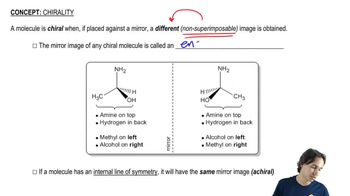
Chirality refers to the geometric property of a molecule that makes it non-superimposable on its mirror image. A chiral molecule typically has a carbon atom bonded to four different substituents, resulting in two distinct forms known as enantiomers. Understanding chirality is crucial for determining the optical activity and biological interactions of compounds.
Recommended video:
Guided course
05:10
What is chirality?

Cis-Trans Isomerism

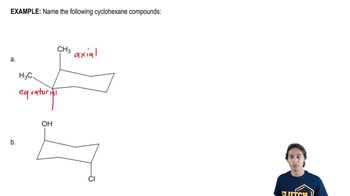
Cis-trans isomerism is a type of stereoisomerism where the spatial arrangement of substituents around a double bond or a ring structure differs. In cis isomers, similar groups are on the same side, while in trans isomers, they are on opposite sides. This concept is essential for analyzing the geometric configurations of compounds like 1,3-dimethylcyclobutane.
Recommended video:
Guided course
00:44
Is the following cyclohexane cis or trans?

Enantiomers

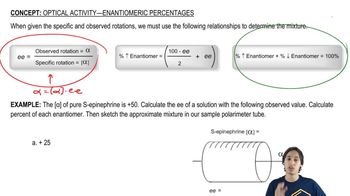
Enantiomers are a pair of chiral molecules that are mirror images of each other but cannot be superimposed. They often exhibit different optical activities and can have distinct biological effects. Identifying enantiomers is important in organic chemistry, especially in the context of drug design and synthesis, as the activity of a drug can depend on its specific enantiomer.
Recommended video:
Guided course
03:23
How to solve for the percentage of each enantiomer.