Draw the product formed when pyridine reacts with ethyl bromide
Verified step by step guidance
1
Identify the functional groups and reactivity of the reactants: Pyridine is an aromatic heterocyclic compound with a nitrogen atom in the ring, and ethyl bromide is an alkyl halide (R-Br). The nitrogen in pyridine has a lone pair of electrons, making it a nucleophile.
Recognize the type of reaction: This is a nucleophilic substitution reaction (SN2 mechanism) because the nitrogen in pyridine will attack the electrophilic carbon in ethyl bromide, displacing the bromide ion (Br⁻).
Determine the site of attack: The lone pair on the nitrogen atom in pyridine will attack the carbon atom bonded to the bromine in ethyl bromide. This forms a bond between the nitrogen and the ethyl group.
Account for the charge: After the nitrogen in pyridine forms a bond with the ethyl group, it will carry a positive charge because it now has four bonds (quaternary ammonium ion).
Draw the product: The final product is an ethylpyridinium ion, where the ethyl group is attached to the nitrogen atom of pyridine, and the bromide ion (Br⁻) is the counterion.
Verified video answer for a similar problem:
This video solution was recommended by our tutors as helpful for the problem above
Video duration:
1m
Play a video:
Was this helpful?
Key Concepts
Here are the essential concepts you must grasp in order to answer the question correctly.
Nucleophilic Substitution
Nucleophilic substitution is a fundamental reaction mechanism in organic chemistry where a nucleophile attacks an electrophile, resulting in the replacement of a leaving group. In the case of pyridine reacting with ethyl bromide, the nitrogen atom in pyridine acts as a nucleophile, attacking the electrophilic carbon bonded to the bromine, leading to the formation of a new bond and the release of bromide ion.
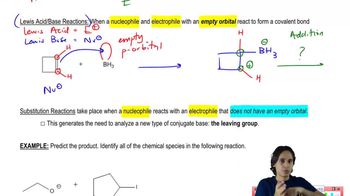
Nucleophiles and Electrophiles can react in Substitution Reactions.
Pyridine Structure and Reactivity
Pyridine is a six-membered aromatic heterocycle containing one nitrogen atom. Its aromatic nature and the presence of a lone pair on the nitrogen make it a weak base and a good nucleophile. Understanding the structure of pyridine is crucial, as it influences its reactivity in nucleophilic substitution reactions, particularly how it interacts with alkyl halides like ethyl bromide.
Alkyl halides are organic compounds containing a carbon atom bonded to a halogen atom (such as bromine). They are often used in nucleophilic substitution reactions due to the polar nature of the carbon-halogen bond, which makes the carbon susceptible to attack by nucleophiles. In this reaction, ethyl bromide serves as the alkyl halide that reacts with pyridine, facilitating the formation of a new product.