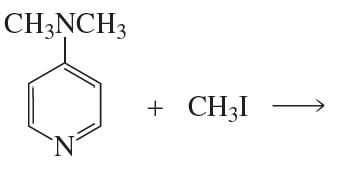
What is the major product of the following reactions? c.
Verified step by step guidance
1
Analyze the reactants: The first reactant is a substituted pyridine with two ethyl groups on the nitrogen and a methyl group on the ring. The second reactant is an alkyl halide, specifically 2-chloropropane.
Identify the reaction type: This is likely a nucleophilic substitution reaction. The nitrogen atom in the pyridine derivative has a lone pair of electrons, making it a nucleophile. The alkyl halide has a good leaving group (Cl), which facilitates substitution.
Determine the site of attack: The nitrogen atom in the pyridine derivative will attack the carbon atom bonded to the chlorine in 2-chloropropane. This is because the carbon is electrophilic due to the electron-withdrawing effect of the chlorine atom.
Predict the product: The nitrogen will form a bond with the carbon, displacing the chlorine atom as the leaving group. The major product will be a quaternary ammonium salt, where the nitrogen is bonded to the alkyl group from 2-chloropropane.
Consider stereochemistry: Since 2-chloropropane is a secondary alkyl halide, the reaction may proceed via an SN2 mechanism, leading to inversion of configuration at the carbon center. Alternatively, if steric hindrance is significant, an SN1 mechanism may occur, resulting in a racemic mixture.
Verified video answer for a similar problem:
This video solution was recommended by our tutors as helpful for the problem above
Video duration:
1m
Play a video:
Was this helpful?
Key Concepts
Here are the essential concepts you must grasp in order to answer the question correctly.
Amine Alkylation
Amine alkylation is a chemical reaction where an amine reacts with an alkyl halide to form a substituted amine. This process typically involves nucleophilic substitution, where the nucleophilic nitrogen atom of the amine attacks the electrophilic carbon of the alkyl halide, displacing the halide ion. Understanding this mechanism is crucial for predicting the major product in reactions involving amines and alkyl halides.
Nucleophilicity refers to the ability of a species to donate an electron pair to an electrophile, forming a chemical bond. In the context of amine alkylation, the nitrogen atom in the amine acts as a nucleophile. Factors such as charge, electronegativity, and steric hindrance influence nucleophilicity, which is essential for determining the reactivity of the amine in the reaction.
Electrophilic substitution is a fundamental reaction mechanism in organic chemistry where an electrophile replaces a substituent in a molecule. In the case of the reaction shown, the alkyl halide acts as the electrophile, and the aromatic amine undergoes substitution. Recognizing the nature of the electrophile and the stability of the resulting product is key to predicting the outcome of the reaction.