Which of the following sugars are reducing sugars? Which ones would undergo mutarotation? (b) α-D-fructofuranosyl-β-D-mannopyranoside
Verified step by step guidance
1
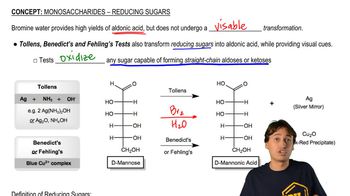
Step 1: Understand the concept of reducing sugars. Reducing sugars are carbohydrates that can act as reducing agents because they have a free aldehyde group (-CHO) or a free ketone group (-C=O) in their open-chain form. These sugars can reduce mild oxidizing agents like Tollens' reagent or Benedict's solution.
Step 2: Analyze the structure of the given sugar, a-D-fructofuranosyl-b-D-mannopyranoside. This is a disaccharide composed of two monosaccharides: D-fructose (a ketose) in its furanose form and D-mannose (an aldose) in its pyranose form. The two monosaccharides are linked via a glycosidic bond.
Step 3: Determine if the glycosidic bond involves the anomeric carbons of both monosaccharides. In this case, the glycosidic bond connects the anomeric carbon of D-fructose (C2) and the anomeric carbon of D-mannose (C1). Since both anomeric carbons are involved in the bond, neither monosaccharide has a free anomeric carbon, meaning the disaccharide cannot act as a reducing sugar.
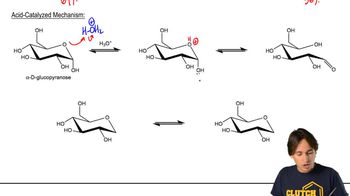
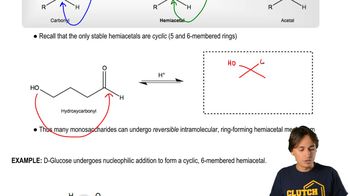
Step 4: Understand the concept of mutarotation. Mutarotation is the change in optical rotation due to the interconversion between alpha and beta anomers of a sugar in solution. For mutarotation to occur, the sugar must have a free anomeric carbon that can open to form the linear structure and then reclose to form either the alpha or beta anomer.
Step 5: Conclude whether mutarotation occurs for the given sugar. Since both anomeric carbons are involved in the glycosidic bond, the sugar cannot undergo mutarotation because neither monosaccharide can open to form the linear structure. Therefore, a-D-fructofuranosyl-b-D-mannopyranoside is neither a reducing sugar nor capable of undergoing mutarotation.
Verified video answer for a similar problem:
This video solution was recommended by our tutors as helpful for the problem above
Video duration:
11m
Play a video:
0 Comments
Key Concepts
Here are the essential concepts you must grasp in order to answer the question correctly.
Reducing Sugars
Reducing sugars are carbohydrates that can donate electrons to other molecules, typically due to the presence of a free aldehyde or ketone group. This property allows them to reduce certain chemical reagents, such as Benedict's or Fehling's solution. Common examples include glucose and fructose, which can exist in open-chain forms that contain these reactive groups.
Mutarotation is the change in optical rotation that occurs when an anomeric carbon in a sugar ring opens and closes, interconverting between its alpha and beta forms. This process is significant in sugars like glucose and fructose, as it leads to a mixture of anomers in solution. The rate of mutarotation can be influenced by factors such as temperature and concentration.
Furanose and pyranose refer to the cyclic forms of sugars, where furanose is a five-membered ring and pyranose is a six-membered ring. The structure of the sugar affects its reactivity and properties, including whether it can act as a reducing sugar. In the case of the sugar mentioned in the question, understanding its ring structure is crucial for determining its reducing ability and mutarotation behavior.


 11:45 minutes
 Verified step by step guidance
 08:42
08:42