Propose a mechanism for the reaction of cyclohexyl methyl ketone with excess bromine in the presence of sodium hydroxide.
Verified step by step guidance
1
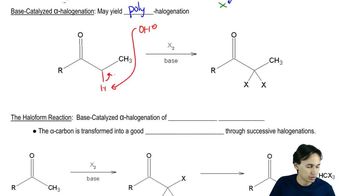
Identify the reaction type: This is a classic example of the haloform reaction, where a methyl ketone reacts with excess bromine in the presence of a base (sodium hydroxide) to produce a carboxylate ion and a haloform (in this case, bromoform).
Step 1: Enolate formation. The base (OH⁻) abstracts an α-hydrogen from the cyclohexyl methyl ketone, forming an enolate ion. The enolate is stabilized by resonance between the oxygen and the α-carbon.
Step 2: Bromination of the enolate. The enolate ion reacts with bromine (Br₂), leading to the substitution of one α-hydrogen with a bromine atom. This step repeats two more times, as excess bromine is present, until all three α-hydrogens on the methyl group are replaced by bromine atoms, forming a tribromo intermediate.
Step 3: Base-induced cleavage. The hydroxide ion attacks the carbonyl carbon of the tribromo intermediate, leading to the formation of a tetrahedral intermediate. This intermediate collapses, expelling the tribromomethane (CHBr₃, bromoform) and forming a carboxylate ion.
Step 4: Final products. The reaction concludes with the formation of cyclohexanecarboxylate ion (the conjugate base of cyclohexanecarboxylic acid) and bromoform (CHBr₃).
Verified video answer for a similar problem:
This video solution was recommended by our tutors as helpful for the problem above
Video duration:
11m
Play a video:
Was this helpful?
Key Concepts
Here are the essential concepts you must grasp in order to answer the question correctly.
Electrophilic Bromination
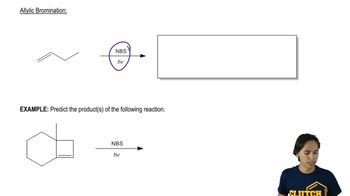
Electrophilic bromination is a reaction where bromine acts as an electrophile, attacking nucleophilic sites in organic molecules. In the case of cyclohexyl methyl ketone, the carbonyl group can enhance the electrophilicity of adjacent carbon atoms, making them more susceptible to bromination. Understanding this mechanism is crucial for predicting the products formed during the reaction.
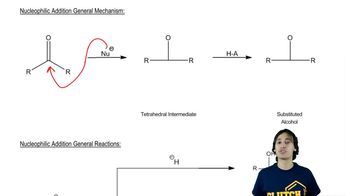
Nucleophilic addition to carbonyls involves the attack of a nucleophile on the electrophilic carbon of a carbonyl group, leading to the formation of an alkoxide intermediate. In the presence of sodium hydroxide, hydroxide ions can act as nucleophiles, facilitating the addition to the carbonyl of cyclohexyl methyl ketone. This step is essential for understanding how the reaction proceeds in the presence of a base.
Base-catalyzed reactions often involve the deprotonation of acidic protons, which can stabilize intermediates or enhance nucleophilicity. In this reaction, sodium hydroxide not only acts as a base but also helps in the formation of more reactive species, such as enolates, which can further react with bromine. Grasping this concept is vital for predicting the overall reaction pathway and the final products.