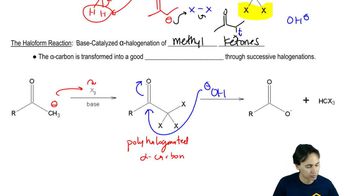
In the presence of excess base and excess halogen, a methyl ketone is converted to a carboxylate ion. The reaction is known as the haloform reaction because one of the products is haloform (chloroform, bromoform, or iodoform). Before spectroscopy became a routine analytical tool, the haloform reaction served as a test for methyl ketones: the formation of iodoform, a bright yellow compound, signaled that a methyl ketone was present. Why do only methyl ketones form a haloform?
Verified step by step guidance
1
The haloform reaction occurs when a methyl ketone reacts with a halogen (Cl₂, Br₂, or I₂) in the presence of a base. The reaction involves multiple steps, including halogenation and cleavage of the carbon-carbon bond adjacent to the carbonyl group.
The key structural feature required for the haloform reaction is the presence of a methyl group directly attached to the carbonyl carbon. This methyl group is essential because it allows for the formation of a trihalogenated intermediate during the reaction.
In the first step, the base deprotonates the alpha-hydrogen of the methyl ketone, forming an enolate ion. This enolate ion is highly nucleophilic and reacts with the halogen to form a halogenated intermediate. This process repeats until the methyl group is fully halogenated, forming a trihalomethyl ketone.
Once the trihalomethyl ketone is formed, the base attacks the carbonyl carbon, leading to cleavage of the carbon-carbon bond. This produces a carboxylate ion and a trihalomethane (haloform, such as chloroform, bromoform, or iodoform).
Only methyl ketones undergo this reaction because the methyl group provides the necessary hydrogens for complete halogenation. Other ketones, such as those with longer alkyl chains, do not have the required structure to form the trihalogenated intermediate and thus cannot produce a haloform.
Verified video answer for a similar problem:
This video solution was recommended by our tutors as helpful for the problem above
Video duration:
4m
Play a video:
Was this helpful?
Key Concepts
Here are the essential concepts you must grasp in order to answer the question correctly.
Haloform Reaction
The haloform reaction is a chemical reaction where a methyl ketone reacts with a halogen in the presence of a base to produce a haloform (such as chloroform, bromoform, or iodoform) and a carboxylate ion. This reaction is significant in organic chemistry as it serves as a qualitative test for the presence of methyl ketones, which can be identified by the formation of the characteristic yellow iodoform.
Methyl ketones are a specific class of ketones characterized by having a methyl group (–CH3) adjacent to the carbonyl group (C=O). This structural feature is crucial for the haloform reaction, as it allows for the necessary deprotonation and subsequent halogenation steps that lead to the formation of haloform products. Other ketones do not have this arrangement, which is why they do not undergo the haloform reaction.
In the haloform reaction, a strong base (such as sodium hydroxide) is essential for deprotonating the methyl ketone, generating an enolate ion. This enolate ion is highly reactive and facilitates the halogenation process, ultimately leading to the formation of the haloform. The presence of excess base ensures that the reaction proceeds efficiently, highlighting the importance of base catalysis in organic reactions.