Draw the product(s) of each of the following reactions: d. o-methylaniline + benzenediazonium chloride
Verified step by step guidance
1
Identify the type of reaction: This is an electrophilic aromatic substitution reaction, specifically an azo coupling reaction. Benzenediazonium chloride acts as an electrophile, and o-methylaniline (an aromatic amine) acts as the nucleophile.
Determine the directing effects of the substituents on o-methylaniline: The -NH2 group (amino group) is an electron-donating group and strongly activates the aromatic ring, directing substitution to the ortho and para positions relative to itself. The -CH3 group (methyl group) is also electron-donating but weaker, and it will not significantly affect the reaction compared to the -NH2 group.
Predict the site of electrophilic attack: Since the -NH2 group is the strongest activator, the azo coupling will occur at the para position relative to the -NH2 group. However, the ortho position relative to the -NH2 group is already occupied by the -CH3 group, so the para position is the most favorable site for the reaction.
Draw the product structure: The product will be an azo compound where the diazonium group (-N≡N⁺) from benzenediazonium chloride couples with the para position of o-methylaniline. The resulting structure will have the -N=N- group connecting the benzene ring of benzenediazonium chloride to the aromatic ring of o-methylaniline.
Verify the stability of the product: Azo compounds are generally stable, and the electron-donating -NH2 group on o-methylaniline further stabilizes the product by resonance. Ensure the final structure reflects the correct connectivity and substituents.
Verified video answer for a similar problem:
This video solution was recommended by our tutors as helpful for the problem above
Video duration:
1m
Play a video:
Was this helpful?
Key Concepts
Here are the essential concepts you must grasp in order to answer the question correctly.
Aromatic Substitution Reactions
Aromatic substitution reactions involve the replacement of a hydrogen atom in an aromatic ring with another atom or group. This process is crucial in organic chemistry, particularly in reactions involving electrophiles and nucleophiles. In the case of o-methylaniline and benzenediazonium chloride, the reaction exemplifies electrophilic aromatic substitution, where the diazonium ion acts as an electrophile.
Diazonium compounds are highly reactive intermediates in organic synthesis, characterized by the presence of a diazonium group (-N2+). They are typically formed from primary aromatic amines and are used to introduce various substituents onto aromatic rings. In this reaction, benzenediazonium chloride serves as the electrophile that will react with o-methylaniline to form a new aromatic compound.
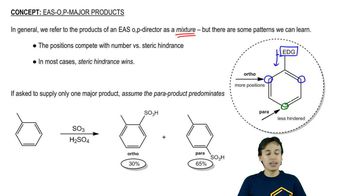
In electrophilic aromatic substitution, the position of the new substituent on the aromatic ring can be ortho (adjacent) or para (opposite) to the original substituent. The directing effects of substituents, such as the amino group in o-methylaniline, influence the outcome of the reaction. In this case, the amino group is an ortho/para director, leading to the formation of products at these positions.