Explain why a diazonium group on a benzene ring cannot be used to direct an incoming substituent to the meta position.
Verified step by step guidance
1
Understand the role of the diazonium group (-N≡N⁺) on a benzene ring. The diazonium group is an electron-withdrawing group due to the positive charge on the nitrogen atom and the triple bond, which pulls electron density away from the benzene ring.
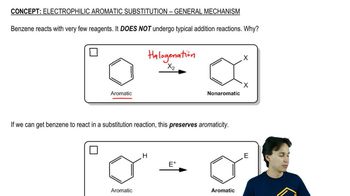
Recall the concept of electrophilic aromatic substitution (EAS). In EAS, the position of substitution is influenced by the electronic effects of substituents already present on the benzene ring. Electron-withdrawing groups typically direct incoming substituents to the meta position, while electron-donating groups direct them to the ortho and para positions.
Analyze the resonance structures of the benzene ring with the diazonium group. The diazonium group does not have resonance structures that stabilize the carbocation intermediate at the meta position during EAS. Instead, it stabilizes the carbocation intermediates at the ortho and para positions through resonance effects.
Recognize that the diazonium group is unique compared to other electron-withdrawing groups. While most electron-withdrawing groups direct substituents to the meta position, the diazonium group stabilizes the ortho and para positions due to its ability to delocalize positive charge through resonance.
Conclude that the diazonium group on a benzene ring cannot direct an incoming substituent to the meta position because it stabilizes the ortho and para positions through resonance effects, making these positions more favorable for substitution.
Verified video answer for a similar problem:
This video solution was recommended by our tutors as helpful for the problem above
Video duration:
4m
Play a video:
Was this helpful?
Key Concepts
Here are the essential concepts you must grasp in order to answer the question correctly.
Diazonium Group
A diazonium group is a functional group characterized by the presence of a nitrogen atom bonded to a benzene ring, typically represented as -N2+. It is highly reactive and can participate in various electrophilic aromatic substitution reactions. However, its presence on the benzene ring influences the reactivity and orientation of incoming substituents due to its electron-withdrawing nature.
Electrophilic aromatic substitution is a fundamental reaction in organic chemistry where an electrophile replaces a hydrogen atom on an aromatic ring. The directing effects of substituents are crucial in determining the position of the incoming electrophile. Substituents can be classified as ortho/para-directing or meta-directing based on their electronic effects, which influence the stability of the intermediate carbocation formed during the reaction.
Substituents on a benzene ring can direct new substituents to specific positions based on their electronic properties. Ortho and para directing groups, such as -OH or -NH2, donate electron density, stabilizing the carbocation intermediate at these positions. In contrast, the diazonium group, being electron-withdrawing, destabilizes the carbocation at the meta position, making it unfavorable for substitution to occur there.