Show how you would synthesize the following ethers in good yield from the indicated starting materials and any additional reagents needed. (f) trans-2,3-epoxyoctane from octan-2-ol
Verified step by step guidance
1
Step 1: Begin with the starting material, octan-2-ol. The hydroxyl group (-OH) on the alcohol will need to be converted into a good leaving group to facilitate the formation of the epoxide.
Step 2: Convert the hydroxyl group into a good leaving group by treating octan-2-ol with a reagent like p-toluenesulfonyl chloride (TsCl) in the presence of a base such as pyridine. This forms the tosylate derivative, which is a better leaving group.
Step 3: Perform an intramolecular Williamson ether synthesis to form the epoxide. Treat the tosylate derivative with a strong base, such as sodium hydride (NaH) or potassium tert-butoxide (KOtBu). The base will deprotonate the adjacent hydroxyl group, creating an alkoxide ion that can attack the carbon bearing the tosylate group in an SN2 reaction, forming the epoxide.
Step 4: Ensure stereochemical control to obtain the trans-2,3-epoxyoctane. The reaction conditions should favor inversion of configuration at the carbon undergoing the SN2 reaction, resulting in the trans product.
Step 5: Purify the product using techniques such as distillation or chromatography to isolate trans-2,3-epoxyoctane in good yield.
Verified video answer for a similar problem:
This video solution was recommended by our tutors as helpful for the problem above
Video duration:
3m
Play a video:
Was this helpful?
Key Concepts
Here are the essential concepts you must grasp in order to answer the question correctly.
Ethers and Their Synthesis
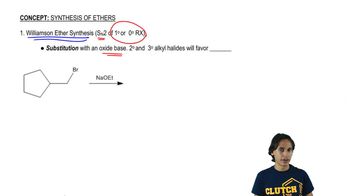
Ethers are organic compounds characterized by an oxygen atom connected to two alkyl or aryl groups. Their synthesis often involves the reaction of alcohols with dehydrating agents or through the Williamson ether synthesis, which utilizes alkoxides and alkyl halides. Understanding these methods is crucial for effectively synthesizing ethers from given starting materials.
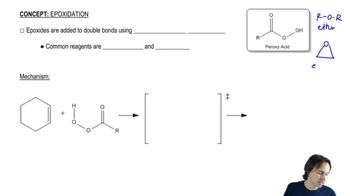
Epoxides are cyclic ethers with a three-membered ring structure that includes an oxygen atom. They can be synthesized from alkenes through reactions with peracids or by the intramolecular cyclization of alcohols. Recognizing how to form epoxides is essential for converting octan-2-ol into trans-2,3-epoxyoctane in the synthesis process.
Stereochemistry refers to the spatial arrangement of atoms in molecules and how this affects their chemical behavior. In the case of trans-2,3-epoxyoctane, understanding the stereochemical implications of the starting material and the reaction conditions is vital for achieving the desired configuration. This knowledge helps predict the outcome of reactions and the stability of the resulting compounds.