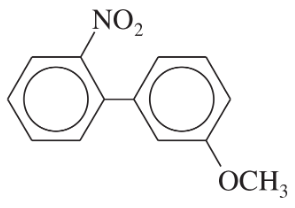
Predict the major products of bromination of the following compounds, using Br2 and FeBr3 in the dark. (a)
Verified step by step guidance
1
Step 1: Analyze the structure of the compound provided. The molecule consists of two benzene rings connected by a single bond. One ring has a nitro group (-NO2) attached, and the other ring has a methoxy group (-OCH3) attached.
Step 2: Understand the directing effects of the substituents. The nitro group is an electron-withdrawing group and acts as a meta-director, while the methoxy group is an electron-donating group and acts as an ortho/para-director.
Step 3: Predict the reactivity of each benzene ring. The ring with the nitro group will be less reactive toward electrophilic bromination due to the electron-withdrawing nature of the nitro group. The ring with the methoxy group will be more reactive due to the electron-donating nature of the methoxy group.
Step 4: Determine the positions where bromination is likely to occur. Bromination will preferentially occur on the benzene ring with the methoxy group at the ortho and para positions relative to the methoxy group, as these positions are activated by the electron-donating effect.
Step 5: Use the catalyst FeBr3 to facilitate the bromination reaction. FeBr3 helps generate the electrophilic bromine species (Br+) from Br2, which then reacts with the activated positions on the benzene ring with the methoxy group.
Verified video answer for a similar problem:
This video solution was recommended by our tutors as helpful for the problem above
Video duration:
5m
Play a video:
Was this helpful?
Key Concepts
Here are the essential concepts you must grasp in order to answer the question correctly.
Electrophilic Aromatic Substitution (EAS)
Electrophilic Aromatic Substitution is a fundamental reaction in organic chemistry where an electrophile replaces a hydrogen atom on an aromatic ring. In this process, the aromatic system retains its stability while introducing new substituents. The reaction typically involves the generation of a sigma complex, followed by deprotonation to restore aromaticity.
Substituents on an aromatic ring can either activate or deactivate the ring towards electrophilic substitution. Activating groups, such as -OCH3, increase the electron density of the ring, making it more reactive, while deactivating groups, like -NO2, withdraw electron density and make the ring less reactive. The nature of these groups also influences the position where substitution occurs.
Regioselectivity refers to the preference of a chemical reaction to yield one structural isomer over others. In the bromination of aromatic compounds, the presence of activating or deactivating groups affects where the bromine will add on the ring. For example, activating groups direct substitution to the ortho and para positions, while deactivating groups typically direct it to the meta position.