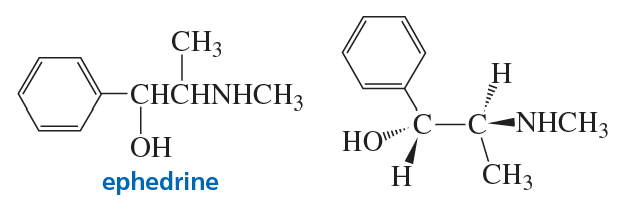
For many centuries, the Chinese have used extracts from a group of herbs known as ephedra to treat asthma. A compound named ephedrine has been isolated from these herbs and found to be a potent dilator of air passages in the lungs. a. How many stereoisomers does ephedrine have? b. The stereoisomer shown here is the one that is pharmacologically active. What is the configuration of each of the asymmetric centers?
Verified step by step guidance
1
Step 1: Identify the asymmetric centers in the structure of ephedrine. An asymmetric center is a carbon atom bonded to four different groups. In the given structure, there are two asymmetric centers: one is the carbon attached to the hydroxyl group (-OH), the phenyl group, a hydrogen atom, and the rest of the chain; the other is the carbon attached to the amino group (-NH2), a methyl group (-CH3), a hydrogen atom, and the rest of the chain.
Step 2: Determine the number of stereoisomers possible for ephedrine. The formula for calculating the number of stereoisomers is 2^n, where n is the number of asymmetric centers. Since ephedrine has two asymmetric centers, the number of stereoisomers is 2^2 = 4.
Step 3: Analyze the configuration of each asymmetric center in the given stereoisomer. To assign the configuration (R or S), use the Cahn-Ingold-Prelog priority rules: assign priorities to the groups attached to the asymmetric center based on atomic number, and determine the spatial arrangement of these groups.
Step 4: For the first asymmetric center (carbon attached to -OH), assign priorities to the groups: phenyl group > hydroxyl group (-OH) > the rest of the chain > hydrogen. Determine the configuration by observing the arrangement of these groups in the given structure.
Step 5: For the second asymmetric center (carbon attached to -NH2), assign priorities to the groups: amino group (-NH2) > methyl group (-CH3) > the rest of the chain > hydrogen. Determine the configuration by observing the arrangement of these groups in the given structure.
Verified video answer for a similar problem:
This video solution was recommended by our tutors as helpful for the problem above
Video duration:
3m
Play a video:
Was this helpful?
Key Concepts
Here are the essential concepts you must grasp in order to answer the question correctly.
Stereoisomerism
Stereoisomerism refers to the phenomenon where compounds have the same molecular formula and connectivity of atoms but differ in the spatial arrangement of their atoms. This can lead to different physical and chemical properties. In the case of ephedrine, it has multiple stereocenters, resulting in several stereoisomers, which can have varying biological activities.
Chirality is a property of a molecule that makes it non-superimposable on its mirror image, often due to the presence of asymmetric centers (chiral centers). Each asymmetric center in a molecule can have two configurations, typically designated as R (rectus) or S (sinister). Understanding the configuration of these centers is crucial for determining the pharmacological activity of compounds like ephedrine.
Pharmacologically active stereoisomers are specific stereoisomers of a compound that exhibit the desired therapeutic effects in biological systems. In the case of ephedrine, only one stereoisomer is responsible for its effectiveness as a bronchodilator. Identifying and understanding the configuration of this active stereoisomer is essential for drug development and therapeutic applications.