Draw condensed and skeletal structures for each of the following amines: e. N,N-dimethyl-3-pentanamine
Verified step by step guidance
1
Step 1: Understand the name of the compound. The name 'N,N-dimethyl-3-pentanamine' indicates that the molecule is an amine with a pentane backbone (5 carbon chain) and two methyl groups attached to the nitrogen atom. The '3-pentanamine' part specifies that the amine group (-NH2) is attached to the third carbon of the pentane chain.
Step 2: Begin by drawing the pentane backbone. Represent the 5 carbon atoms in a straight chain, labeling them as C1, C2, C3, C4, and C5.
Step 3: Place the amine group (-NH2) on the third carbon (C3). Since the name specifies 'N,N-dimethyl,' replace the two hydrogens on the nitrogen atom with two methyl groups (-CH3). This creates the N,N-dimethyl substitution.
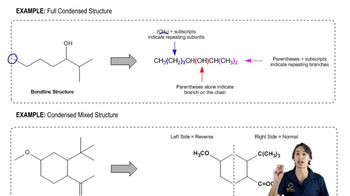
Step 4: Draw the condensed structure. Write the molecular formula in a compact form, showing the connectivity of the atoms. For example, the condensed structure would look like CH3CH2CH(N(CH3)2)CH2CH3.
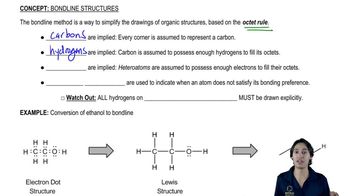
Step 5: Draw the skeletal structure. Use zigzag lines to represent the carbon chain, omitting hydrogens bonded to carbons for simplicity. Show the nitrogen atom bonded to the third carbon, with two methyl groups attached to the nitrogen. Ensure the skeletal structure clearly represents the connectivity and geometry of the molecule.
Verified video answer for a similar problem:
This video solution was recommended by our tutors as helpful for the problem above
Video duration:
6m
Play a video:
Was this helpful?
Key Concepts
Here are the essential concepts you must grasp in order to answer the question correctly.
Amines
Amines are organic compounds derived from ammonia (NH3) by replacing one or more hydrogen atoms with alkyl or aryl groups. They can be classified as primary, secondary, or tertiary based on the number of carbon-containing groups attached to the nitrogen atom. Understanding the structure and classification of amines is essential for drawing their condensed and skeletal forms.
Condensed structures provide a simplified representation of a molecule, showing the connectivity of atoms without depicting all the bonds explicitly. In the case of amines, the condensed structure will indicate the nitrogen atom's connectivity to its substituents, allowing for a quick understanding of the molecular framework. This format is particularly useful for larger molecules where full structural formulas would be cumbersome.
Skeletal structures, or line-angle formulas, represent organic molecules using lines to depict bonds between carbon atoms, with vertices representing carbon atoms and other elements (like nitrogen) shown explicitly. This method emphasizes the carbon backbone and is particularly useful for visualizing complex organic molecules, making it easier to identify functional groups and overall molecular geometry.