a. What is each compound’s systematic name? b. Draw a skeletal structure for each condensed structure given and draw a condensed structure for each skeletal structure. 5. BrCH2CH2CH2CH2CH2NHCH2CH3 6.
Verified step by step guidance
1
Step 1: Analyze the condensed structure provided for compound 5 (BrCH2CH2CH2CH2CH2NHCH2CH3). Identify the functional groups present. The molecule contains a bromine atom (Br), an amine group (-NH-), and a hydrocarbon chain.
Step 2: Assign the systematic name for compound 5. Begin by identifying the longest carbon chain, which is a seven-carbon chain. Number the chain starting from the end closest to the bromine substituent to give it the lowest possible number. The amine group is treated as a substituent.
Step 3: Draw the skeletal structure for compound 5. Represent the carbon chain as a zigzag line, place the bromine atom on the first carbon, and the amine group on the sixth carbon. Add the ethyl group (-CH2CH3) attached to the nitrogen atom.
Step 4: For compound 6 (skeletal structure provided in the image), identify the longest continuous carbon chain. This chain has six carbons. Determine the substituents and their positions based on the skeletal structure. The substituents are methyl groups attached to carbons 2, 3, and 4.
Step 5: Assign the systematic name for compound 6. Number the chain to give the substituents the lowest possible numbers. The name will include the positions and names of the substituents followed by the name of the parent chain (hexane). Convert the skeletal structure into a condensed structure by writing out each carbon and its attached hydrogens explicitly.
Verified video answer for a similar problem:
This video solution was recommended by our tutors as helpful for the problem above
Video duration:
8m
Play a video:
Was this helpful?
Key Concepts
Here are the essential concepts you must grasp in order to answer the question correctly.
Systematic Naming
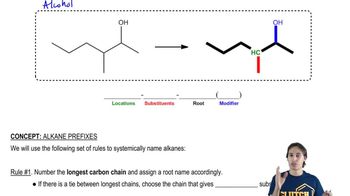
Systematic naming in organic chemistry follows the IUPAC (International Union of Pure and Applied Chemistry) rules, which provide a standardized method for naming compounds based on their structure. This includes identifying the longest carbon chain, determining the functional groups, and assigning locants to indicate the position of substituents. For example, the compound BrCH2CH2CH2CH2CH2NHCH2CH3 would be systematically named as 1-bromo-hexan-1-amine.
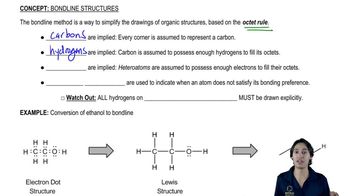
Skeletal structures are a simplified way of representing organic molecules, where carbon atoms are represented by vertices and hydrogen atoms are implied. This notation omits hydrogen atoms attached to carbons, making it easier to visualize complex molecules. Understanding how to convert condensed structures to skeletal structures is essential for interpreting molecular geometry and connectivity.
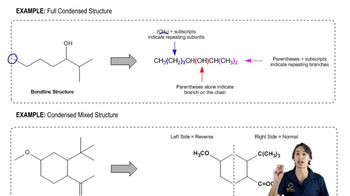
Condensed structures provide a way to represent organic compounds by showing the arrangement of atoms in a linear format, often indicating the connectivity of atoms without depicting all bonds explicitly. For example, in the condensed structure BrCH2CH2CH2CH2CH2NHCH2CH3, the arrangement of bromine, carbon, and nitrogen atoms is clearly outlined, which aids in understanding the molecular framework before converting to skeletal structures.