
a. Under thermal conditions, will ring closure of (2E,4Z,6Z,8E)-2,4,6,8-decatetraene be conrotatory or disrotatory? b. Will the product have the cis or the trans configuration?
Verified step by step guidance
1
Analyze the problem: The question involves the electrocyclic ring closure of a conjugated polyene under thermal conditions. This requires applying the Woodward-Hoffmann rules, which are based on the conservation of orbital symmetry.
Step 1: Determine the number of π-electrons in the system. The molecule (2E,4Z,6Z,8E)-2,4,6,8-decatetraene has four conjugated double bonds, meaning it has 4 × 2 = 8 π-electrons.
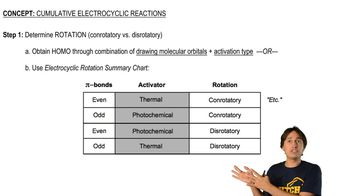
Step 2: Apply the Woodward-Hoffmann rules for thermal conditions. For a system with 4n π-electrons (where n is an integer), the ring closure will proceed via a conrotatory mechanism under thermal conditions.
Step 3: Predict the stereochemistry of the product. In a conrotatory mechanism, the terminal groups of the polyene rotate in the same direction (either both clockwise or both counterclockwise). This rotation determines whether the product will have a cis or trans configuration.
Step 4: Examine the initial stereochemistry of the molecule. The (2E,4Z,6Z,8E) configuration specifies the spatial arrangement of the substituents on the double bonds. Use this information to visualize how the conrotatory motion affects the final stereochemistry of the product.
Verified video answer for a similar problem:
This video solution was recommended by our tutors as helpful for the problem above
Video duration:
3m
Play a video:
Was this helpful?
Key Concepts
Here are the essential concepts you must grasp in order to answer the question correctly.
Conrotatory vs. Disrotatory Ring Closure
In organic chemistry, the terms conrotatory and disrotatory refer to the specific types of stereochemical outcomes during the ring closure of conjugated systems under thermal conditions. Conrotatory closure involves both ends of the molecule rotating in the same direction, while disrotatory closure involves them rotating in opposite directions. The type of closure is determined by the number of π-bonds and the stereochemistry of the starting material.
Two Steps to Predicting Any Electrocyclic Products
Woodward-Hoffmann Rules
The Woodward-Hoffmann rules provide a framework for predicting the stereochemical outcomes of pericyclic reactions, including cyclizations. These rules are based on the conservation of orbital symmetry and dictate whether a reaction will proceed via a conrotatory or disrotatory mechanism, depending on the number of π-electrons involved. For a system with 4n π-electrons, the conrotatory pathway is favored, while for 4n+2 π-electrons, the disrotatory pathway is preferred.
Cis and trans configurations refer to the spatial arrangement of substituents around a double bond or a ring structure. In a cis configuration, substituents are on the same side, while in a trans configuration, they are on opposite sides. The configuration of the product formed from the ring closure of (2E,4Z,6Z,8E)-2,4,6,8-decatetraene will depend on the stereochemical pathway taken during the reaction, influencing the final spatial arrangement of the substituents.