Predict the products from crossed Claisen condensation of the following pairs of esters. Indicate which combinations are poor choices for crossed Claisen condensations. (a) (b)
Verified step by step guidance
1
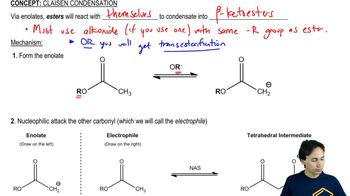
Step 1: Understand the Claisen condensation reaction. It involves the reaction of two esters in the presence of a strong base to form a β-keto ester or a β-diketone. Crossed Claisen condensation refers to the reaction between two different esters.
Step 2: Identify the esters involved in the reaction. Examine the structures provided in the images for both parts (a) and (b). Note the alkyl groups attached to the ester functional groups.
Step 3: Consider the reactivity of the esters. Esters with α-hydrogens are more reactive in Claisen condensations because they can form enolates. Determine which esters have α-hydrogens available for enolate formation.
Step 4: Predict the products. The enolate formed from one ester will attack the carbonyl carbon of the other ester, leading to the formation of a new carbon-carbon bond. Write the structure of the expected β-keto ester or β-diketone product for each pair of esters.
Step 5: Evaluate the suitability of the ester pairs for crossed Claisen condensation. Poor choices typically involve esters that lack α-hydrogens or have steric hindrance that prevents effective enolate formation or attack. Indicate which combinations are less favorable based on these criteria.
Verified video answer for a similar problem:
This video solution was recommended by our tutors as helpful for the problem above
Video duration:
5m
Play a video:
Was this helpful?
Key Concepts
Here are the essential concepts you must grasp in order to answer the question correctly.
Claisen Condensation
Claisen condensation is a reaction between two esters or an ester and a carbonyl compound in the presence of a strong base, leading to the formation of a β-keto ester or a β-diketone. This reaction involves the nucleophilic attack of an enolate ion derived from one ester on the carbonyl carbon of another, resulting in a new carbon-carbon bond. Understanding this mechanism is crucial for predicting the products of crossed Claisen condensations.
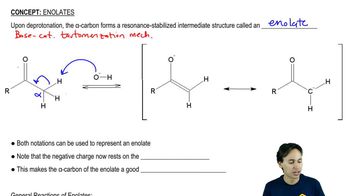
Enolate ions are formed when a strong base abstracts a proton from the α-carbon of an ester, creating a resonance-stabilized anion. This enolate can act as a nucleophile in Claisen condensation reactions. The stability of the enolate ion is influenced by the structure of the ester, making it essential to identify which esters can effectively generate enolates for successful crossed Claisen reactions.
Crossed Claisen condensation involves the reaction of two different esters, which can lead to multiple products depending on the reactivity of the esters involved. Some combinations may yield poor results due to the possibility of self-condensation or the formation of unreactive enolates. Identifying which ester pairs are likely to react favorably is key to predicting the products and understanding the limitations of this reaction.