Predict the products of the following Claisen condensations. (c)
Verified step by step guidance
1
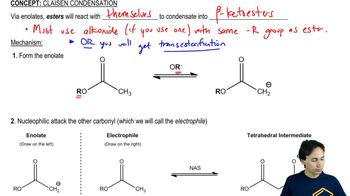
Step 1: Recognize that this is a Dieckmann condensation, which is an intramolecular Claisen condensation. It involves the reaction of a diester with a base to form a cyclic β-keto ester.
Step 2: Identify the two ester groups in the molecule. The molecule contains two ester functionalities: one at the end of the chain and another in the middle. The reaction will proceed by forming a cyclic structure.
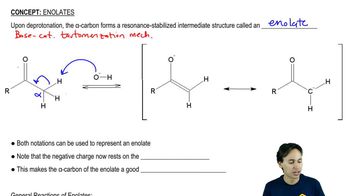
Step 3: Determine the nucleophilic site. The base (methoxide ion, CH₃O⁻) will deprotonate the α-hydrogen of one of the ester groups, creating an enolate ion. This enolate will act as a nucleophile.
Step 4: Predict the intramolecular attack. The enolate ion will attack the carbonyl carbon of the other ester group, leading to the formation of a new C-C bond and a cyclic intermediate.
Step 5: Finalize the product structure. After the intramolecular attack, the intermediate undergoes protonation and elimination of methoxide (CH₃O⁻), resulting in a cyclic β-keto ester as the final product. The ring size will depend on the number of carbons between the two ester groups.
Verified video answer for a similar problem:
This video solution was recommended by our tutors as helpful for the problem above
Video duration:
4m
Play a video:
Was this helpful?
Key Concepts
Here are the essential concepts you must grasp in order to answer the question correctly.
Claisen Condensation
Claisen condensation is a reaction between two esters or an ester and a carbonyl compound in the presence of a strong base, typically sodium ethoxide. This reaction results in the formation of a β-keto ester or a β-diketone. Understanding this mechanism is crucial for predicting the products, as it involves nucleophilic attack and subsequent elimination of an alcohol.
Nucleophilic acyl substitution is a fundamental reaction in organic chemistry where a nucleophile attacks an acyl compound, leading to the substitution of a leaving group. In the context of Claisen condensation, the enolate ion formed from one ester acts as the nucleophile, attacking the carbonyl carbon of another ester. This concept is essential for understanding how the products are formed during the reaction.
Nucleophiles and Electrophiles can react in Substitution Reactions.
Enolate Ion Formation
Enolate ions are reactive intermediates formed when a base abstracts a proton from the α-carbon of a carbonyl compound, resulting in a resonance-stabilized anion. In Claisen condensation, the formation of the enolate ion is a critical step, as it serves as the nucleophile that initiates the reaction. Recognizing how enolate ions are generated and their role in the reaction mechanism is vital for predicting the final products.