For each compound, determine whether the molecule has an internal mirror plane of symmetry. If it does, draw the mirror plane on a three-dimensional drawing of the molecule. If the molecule does not have an internal mirror plane, determine whether the structure is chiral.a. Methaneb. cis-1,2-dibromocyclobutanec. trans-1,2-dibromocyclobutane
Verified step by step guidance
1
Identify the molecular geometry and symmetry elements of each compound.
For methane (CH₄), recognize that it is a tetrahedral molecule with high symmetry, including multiple mirror planes.
For cis-1,2-dibromocyclobutane, draw the cyclobutane ring in a three-dimensional perspective and place the bromine atoms on the same side of the ring. Check for a mirror plane that bisects the molecule.
For trans-1,2-dibromocyclobutane, draw the cyclobutane ring in a three-dimensional perspective and place the bromine atoms on opposite sides of the ring. Check for any mirror planes and assess chirality.
Determine the presence of a mirror plane for each compound and conclude whether each molecule is chiral or achiral based on the presence or absence of symmetry.
Verified video answer for a similar problem:
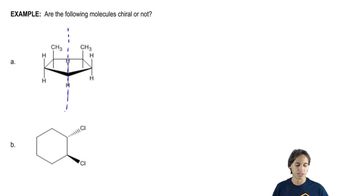
This video solution was recommended by our tutors as helpful for the problem above
Video duration:
4m
Play a video:
Was this helpful?
Key Concepts
Here are the essential concepts you must grasp in order to answer the question correctly.
Symmetry in Molecules
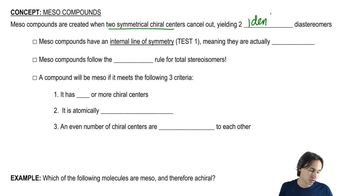
Symmetry in molecules refers to the arrangement of atoms in a way that allows for a mirror image to be created. A molecule has an internal mirror plane of symmetry if it can be divided into two identical halves by a plane. This concept is crucial for determining the symmetry properties of a compound, which can influence its physical and chemical behavior.
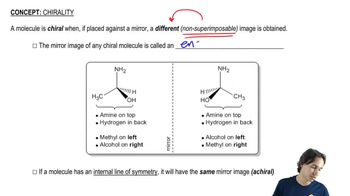
Chirality is a property of a molecule that makes it non-superimposable on its mirror image, much like left and right hands. A chiral molecule typically has no internal mirror plane of symmetry and often contains a carbon atom bonded to four different substituents. Understanding chirality is essential for predicting the optical activity of compounds and their interactions in biological systems.
Cyclic compounds, such as cyclobutane, can exhibit different forms of isomerism, including cis and trans configurations. The arrangement of substituents around the ring can affect the molecule's symmetry and chirality. Recognizing these isomeric forms is important for analyzing the spatial arrangement of atoms and determining the presence of symmetry elements in cyclic structures.