a. Predict the relative bond lengths of the three carbon–oxygen bonds in the carbonate ion. b. What is the charge on each oxygen?
Verified step by step guidance
1
Step 1: Analyze the structure of the carbonate ion (CO₃²⁻). The carbonate ion consists of one carbon atom bonded to three oxygen atoms. It has a resonance structure, meaning the electrons are delocalized across the molecule.
Step 2: Predict the relative bond lengths. Due to resonance, the three carbon–oxygen bonds in the carbonate ion are equivalent. The delocalization of electrons results in bond lengths that are intermediate between a single bond and a double bond. Therefore, all three C–O bonds have the same length.
Step 3: Determine the charge distribution. The carbonate ion has a total charge of -2. This charge is distributed across the three oxygen atoms due to resonance. Each oxygen atom carries a partial negative charge.
Step 4: Use formal charge calculations to confirm the charge on each oxygen. The formal charge on each oxygen can be calculated using the formula: Formal charge = (Valence electrons) - (Non-bonding electrons) - (Bonding electrons/2). For the carbonate ion, each oxygen atom has a formal charge of -2/3 due to the resonance structure.
Step 5: Summarize the findings. The three carbon–oxygen bonds in the carbonate ion are of equal length due to resonance, and each oxygen atom carries a partial negative charge, contributing to the overall -2 charge of the ion.
Verified video answer for a similar problem:
This video solution was recommended by our tutors as helpful for the problem above
Video duration:
4m
Play a video:
Was this helpful?
Key Concepts
Here are the essential concepts you must grasp in order to answer the question correctly.
Resonance Structures
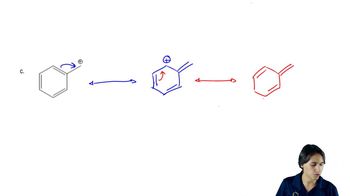
Resonance structures are different ways of drawing the same molecule that illustrate the delocalization of electrons. In the case of the carbonate ion (CO3^2-), there are three resonance forms, each showing a different oxygen atom with a double bond to carbon. This delocalization leads to bond lengths that are intermediate between single and double bonds, affecting the overall stability and properties of the ion.
Bond length refers to the distance between the nuclei of two bonded atoms. In the carbonate ion, the bond lengths of the carbon-oxygen bonds are influenced by the resonance structures. The C=O bond (double bond) is shorter than the C-O bond (single bond), resulting in all three C-O bonds being of equal length due to resonance, which is typically shorter than a single bond but longer than a double bond.
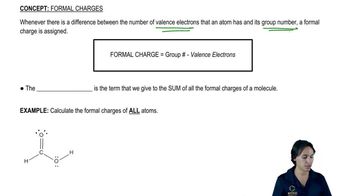
Formal charge is a theoretical charge assigned to an atom in a molecule, calculated based on the number of valence electrons, the number of non-bonding electrons, and half the number of bonding electrons. In the carbonate ion, each oxygen atom carries a formal charge of -2/3 due to the distribution of electrons across the resonance structures, which helps to stabilize the ion and explains the overall -2 charge of the carbonate ion.