Show how you would accomplish the following syntheses efficiently and in good yield. You may use any necessary reagents. (a) acetaldehyde → lactic acid, CH3CH(OH)COOH
Verified step by step guidance
1
Step 1: Begin with acetaldehyde (CH3CHO) as the starting material. Recognize that the target molecule, lactic acid (CH3CH(OH)COOH), contains both a hydroxyl (-OH) group and a carboxylic acid (-COOH) group. This suggests that oxidation and hydroxylation reactions will be required.
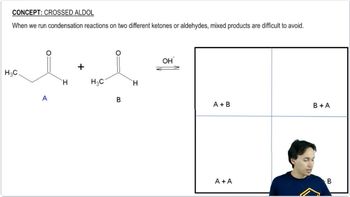
Step 2: Perform an aldol addition reaction. Treat acetaldehyde with a base such as NaOH to generate an enolate ion. The enolate ion will attack another molecule of acetaldehyde, forming a β-hydroxyaldehyde intermediate (CH3CH(OH)CH=O).
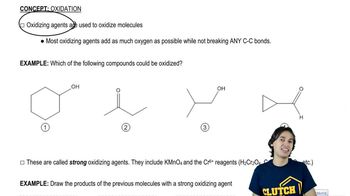
Step 3: Oxidize the aldehyde group (-CHO) in the β-hydroxyaldehyde intermediate to a carboxylic acid (-COOH). Use a mild oxidizing agent such as Tollens' reagent (Ag(NH3)2+) or a stronger oxidizing agent like KMnO4 under controlled conditions to achieve this transformation, yielding lactic acid.
Step 4: Ensure stereochemical control during the synthesis. The hydroxyl group (-OH) in lactic acid is chiral, so consider reaction conditions that favor the formation of the desired stereoisomer if stereochemistry is important.
Step 5: Purify the product using techniques such as recrystallization or chromatography to isolate lactic acid in good yield and high purity.
Verified video answer for a similar problem:
This video solution was recommended by our tutors as helpful for the problem above
Video duration:
7m
Play a video:
Was this helpful?
Key Concepts
Here are the essential concepts you must grasp in order to answer the question correctly.
Aldol Condensation
Aldol condensation is a key reaction in organic chemistry where aldehydes or ketones with alpha-hydrogens react in the presence of a base to form β-hydroxy aldehydes or ketones. This reaction is crucial for synthesizing larger molecules, such as lactic acid from acetaldehyde, by forming a carbon-carbon bond through the enolate ion mechanism.
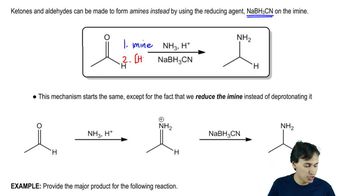
Reduction reactions involve the gain of electrons or hydrogen, or the loss of oxygen, resulting in the conversion of carbonyl compounds to alcohols. In the synthesis of lactic acid from acetaldehyde, the β-hydroxy aldehyde formed from aldol condensation can be further reduced to yield lactic acid, highlighting the importance of reduction in organic synthesis.
The choice of reagents and reaction conditions is critical in organic synthesis. For the conversion of acetaldehyde to lactic acid, a strong base (like sodium hydroxide) is needed for the aldol condensation, followed by a reducing agent (such as lithium aluminum hydride) to facilitate the reduction step. Understanding the role of these reagents ensures efficient and high-yield synthesis.