Show how you would synthesize octanal from each compound. You may use any necessary reagents. (a) octan-1-ol
Verified step by step guidance
1
Identify the functional group in the starting compound, octan-1-ol. It contains a primary alcohol (-OH) group attached to the first carbon of an eight-carbon chain.
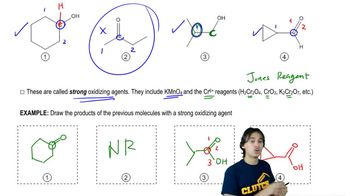
Recall that to synthesize an aldehyde (octanal) from a primary alcohol, a mild oxidation reaction is required. Strong oxidizing agents would over-oxidize the alcohol to a carboxylic acid, so a selective oxidizing agent is necessary.
Choose an appropriate reagent for mild oxidation. Common reagents include PCC (Pyridinium Chlorochromate) or DMP (Dess-Martin Periodinane), which selectively oxidize primary alcohols to aldehydes without further oxidation to carboxylic acids.
Write the reaction mechanism: The primary alcohol undergoes oxidation, where the hydroxyl group (-OH) is converted into a carbonyl group (C=O) on the same carbon, resulting in the formation of octanal.
Ensure proper reaction conditions: Perform the reaction in an anhydrous solvent (e.g., dichloromethane) to prevent over-oxidation and maintain the aldehyde as the final product.
Verified video answer for a similar problem:
This video solution was recommended by our tutors as helpful for the problem above
Video duration:
5m
Play a video:
Was this helpful?
Key Concepts
Here are the essential concepts you must grasp in order to answer the question correctly.
Oxidation of Alcohols
The conversion of alcohols to aldehydes or ketones involves oxidation reactions. In the case of primary alcohols like octan-1-ol, oxidation can be achieved using reagents such as potassium dichromate or PCC (pyridinium chlorochromate). This process transforms the hydroxyl (-OH) group into a carbonyl (C=O) group, yielding octanal as the product.
Understanding the appropriate reagents for organic synthesis is crucial. For synthesizing octanal from octan-1-ol, oxidizing agents like CrO3 or Na2Cr2O7 can be used. Additionally, knowledge of reaction conditions, such as temperature and solvent, is essential to ensure the desired transformation occurs efficiently and selectively.
Synthesis of Amino Acids: Strecker Synthesis Example 1
Functional Group Transformation
Functional group transformation is a key concept in organic chemistry, where one functional group is converted into another. In this case, the transformation of the alcohol functional group (-OH) in octan-1-ol to the aldehyde functional group (C=O) in octanal is a classic example. This concept is fundamental for understanding how to manipulate organic compounds to achieve desired products.