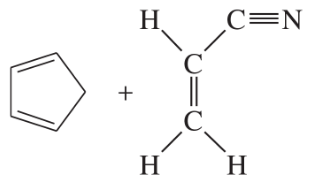
Predict the major product for each proposed Diels–Alder reaction. Include stereochemistry where appropriate. (a)
Verified step by step guidance
1
Step 1: Identify the components of the Diels–Alder reaction. The reaction involves a conjugated diene (cyclopentadiene) and a dienophile (an alkene with an electron-withdrawing group, in this case, the aldehyde group).
Step 2: Analyze the electron-withdrawing group on the dienophile. The aldehyde group (-CHO) is highly electron-withdrawing, which makes the dienophile more reactive in the Diels–Alder reaction.
Step 3: Determine the regiochemistry of the reaction. The electron-withdrawing group on the dienophile will direct the reaction such that the new bonds form in a way that maximizes stability. The aldehyde group will typically align with the electron-rich ends of the diene.
Step 4: Predict the stereochemistry of the product. The Diels–Alder reaction is stereospecific, meaning that the stereochemistry of the dienophile and diene is preserved in the product. The reaction will produce a bicyclic compound with the substituents on the dienophile (the aldehyde group) oriented endo (toward the larger ring system).
Step 5: Draw the major product structure. Combine the diene and dienophile to form a bicyclic compound, ensuring the aldehyde group is positioned endo relative to the newly formed ring system. The product will have two new sigma bonds and a six-membered ring fused to the original cyclopentadiene structure.
Verified video answer for a similar problem:
This video solution was recommended by our tutors as helpful for the problem above
Video duration:
5m
Play a video:
Was this helpful?
Key Concepts
Here are the essential concepts you must grasp in order to answer the question correctly.
Diels–Alder Reaction
The Diels–Alder reaction is a [4+2] cycloaddition reaction between a conjugated diene and a dienophile, resulting in the formation of a six-membered ring. This reaction is a key method in organic synthesis for constructing cyclic compounds and is characterized by its stereospecificity, meaning the stereochemistry of the reactants is preserved in the product.
Stereochemistry refers to the study of the spatial arrangement of atoms in molecules and how this affects their chemical behavior. In the context of the Diels–Alder reaction, understanding stereochemistry is crucial for predicting the configuration of the product, as the reaction can lead to the formation of chiral centers and specific stereoisomers based on the orientation of the reactants.
In organic chemistry, the reactivity of molecules is often influenced by their electron density. In the Diels–Alder reaction, the diene must be electron-rich, while the dienophile is typically electron-poor, allowing for effective overlap of their molecular orbitals. This concept is essential for predicting which reactants will undergo the reaction and the nature of the resulting product.