Textbook Question
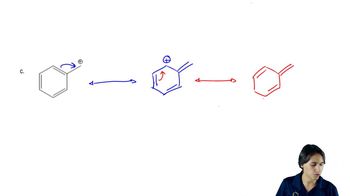
Which of the following has delocalized electrons?
g.
h.
i.
1905
views
1
rank

 Bruice 8th EditionCh. 8 - Delocalized Electrons: Their Effect on Stability, pKa, and the Products of a Reaction • Aromaticity and Electronic Effects: An Introduction to the Reactions of BenzeneProblem 61j,k,l


 Verified step by step guidance
 03:54
03:54
 03:04
03:04 08:19
08:19Which of the following has delocalized electrons?
g.
h.
i.
Refer to the electrostatic potential maps <IMAGE> to answer the following questions:
c. Why is the center of the electrostatic potential map of benzene more red than the center of the electrostatic potential map of pyridine?
a. Draw resonance contributors for the following species, showing all the lone pairs:
b. For each species, indicate the most stable resonance contributor.
3. NO2-
Draw resonance contributors for the following ions:
a.
Draw resonance contributors for the following ions:
d.
Which of the following has delocalized electrons?
a.
b.
c.